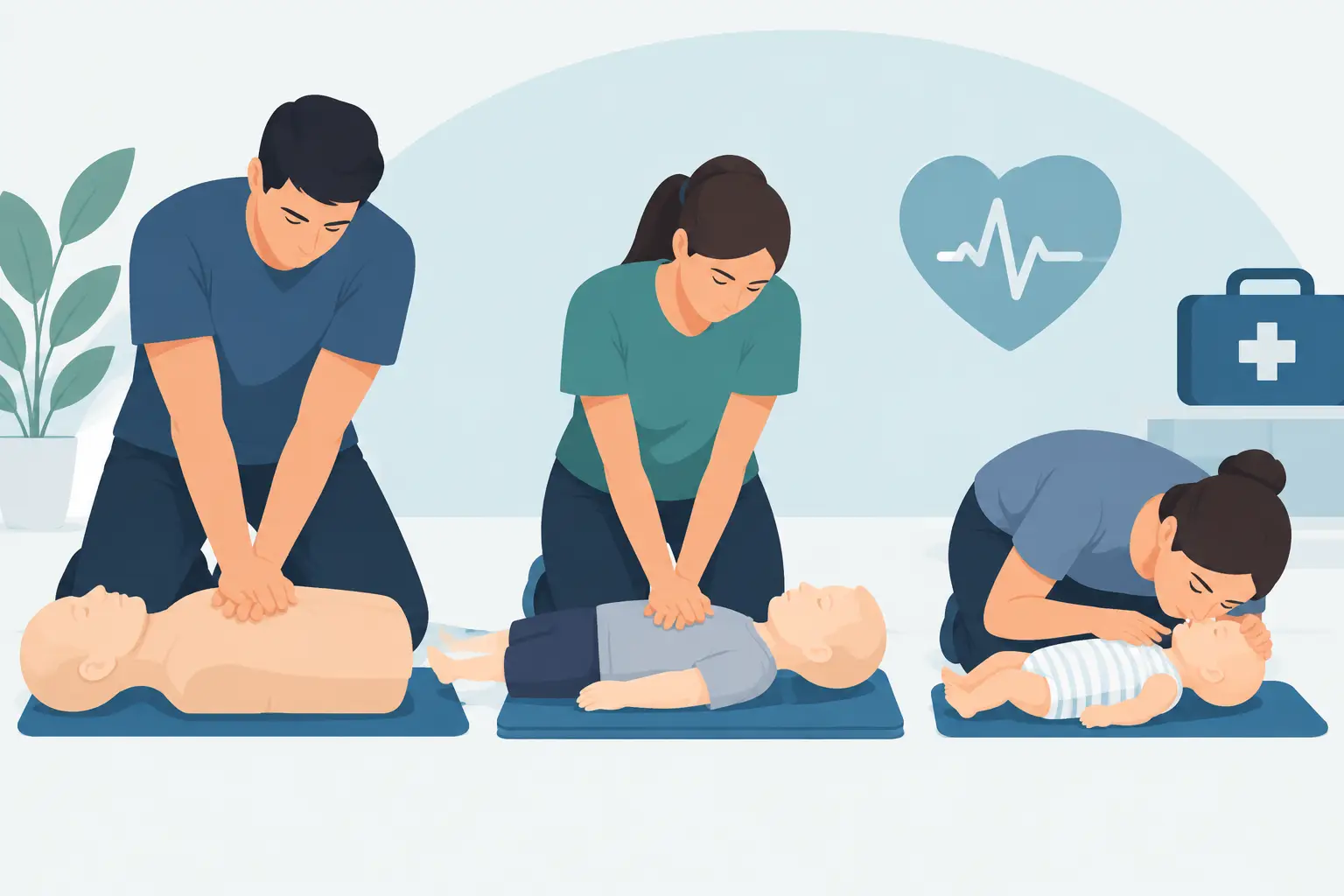
Adult Child Infant CPR Training for Real Readiness
A collapsed coworker in a hallway, a child pulled from a pool, or an infant who suddenly becomes unresponsive all demand the same first decision: act. Adult child infant CPR training prepares people to recognize the emergency, begin appropriate care, use available equipment, and work effectively until EMS arrives. The age of the patient changes the technique and likely cause, but hesitation is dangerous at every age.
Preparedness is a responsibility, not just a card. For healthcare personnel, child care teams, school staff, church safety teams, coaches, and families, training across all three age groups closes a critical gap. A responder who has only practiced on an adult manikin may know CPR in theory but lose valuable seconds when faced with an infant or young child.
Why Training Across Age Groups Matters
CPR is not one interchangeable skill. The core priorities remain early recognition, rapid activation of emergency response, high-quality compressions, effective ventilation when indicated, and early defibrillation when available. How those priorities are applied changes with the patient's age, size, anatomy, and most likely cause of collapse.
Adults often experience sudden cardiac events, making rapid CPR and early AED use especially urgent. Children and infants are more likely to deteriorate after respiratory failure, drowning, choking, trauma, or another breathing-related emergency. That difference is why high-quality ventilation carries particular importance in pediatric resuscitation. It is also why a course that treats pediatric CPR as a brief add-on does not create the same level of readiness as hands-on practice.
For organizations, the need is operational as well as clinical. A nursing home may care for adults but employ staff who respond to visitors and family members. A school, church, athletic program, or daycare may have adults, children, and infants on site at the same time. The first responder cannot postpone action while deciding whether the training they received applies to the person in front of them.
What Adult, Child, and Infant CPR Training Teaches
Adult response: rapid action and AED readiness
Adult CPR training emphasizes recognition of unresponsiveness and abnormal breathing, immediate activation of the emergency response system, effective compressions, and prompt AED application. Teams also practice clear role assignment: one person begins care, another calls 911, and another retrieves the AED. In a workplace or clinical setting, those roles must become automatic.
An AED should not be treated as equipment reserved for trained medical personnel. Modern devices provide prompts, but confidence with pad placement, minimizing interruptions, and maintaining scene control comes from practice. Responders also need to understand that an AED may advise a shock or may direct them to continue CPR. Both outcomes require disciplined action.
Child response: technique adjusted to the patient
Children are not small adults. Their body size requires age-appropriate hand placement and compression technique, while their emergencies may involve breathing problems before cardiac arrest. Training should give learners time to practice the mechanics on child manikins rather than merely watch a demonstration.
A capable course also addresses the judgment calls that can slow a lone responder. When should emergency services be activated? When should an AED be brought to the scene? How does the response change if the collapse was witnessed versus discovered after an unknown period? Current, instructor-led training helps participants apply guideline-based priorities without substituting guesswork for a practiced response.
Infant response: precision matters most
Infant CPR demands deliberate technique. An infant's airway position, chest size, and fragility leave little room for forceful or poorly placed actions. Learners need guided practice with infant manikins to develop correct hand position, compression depth, ventilation technique, and a safe approach to suspected airway obstruction.
The difference between a single-rescuer technique and a team-based technique matters as well. Instructors can coach participants through these distinctions, correct errors immediately, and explain how care changes once another rescuer or EMS arrives. Watching a video cannot provide that correction. A manikin, an experienced instructor, and repeated skill practice can.
Hands-On Practice Is the Standard That Counts
A certificate confirms course completion. It does not, by itself, prove a person can perform during a stressful emergency. That confidence is built when learners physically practice the sequence, hear feedback, make mistakes in a controlled setting, and repeat the skill until their actions become more reliable.
Effective adult child infant CPR training should include realistic practice with adult, child, and infant manikins, plus AED trainers and emergency scenarios. Participants should practice recognizing ineffective compressions, managing the transition between solo and team response, communicating with bystanders, and maintaining care while the AED is prepared. Those details are often where real-world response becomes disorganized.
EMS-informed instructors add value because they teach beyond the testing checklist. They can explain why a delayed call for help creates problems, why quality drops when rescuers fail to rotate, and why a calm, direct command can turn bystanders into useful support. The goal is competent action under pressure, not memorizing a script for one skills test.
Choosing the Right Course for Your Role
The right level of training depends on where and how you may be expected to respond. Community CPR training is a practical choice for parents, grandparents, coaches, volunteers, and anyone who wants the ability to help before professional responders arrive. It focuses on the essential skills needed to act with confidence in public, at home, or during youth activities.
Healthcare personnel and healthcare entrants generally need a BLS course that meets their employer, school, credentialing, or clinical-placement requirements. BLS training builds on core CPR by emphasizing team dynamics, professional rescue expectations, and high-performance response. A renewal course may be appropriate for professionals with a qualifying current or recently expired credential, while new entrants should choose initial certification when required.
Cost and convenience matter, but course quality should not be sacrificed for a quick card. Ask whether learners will practice on all three patient types, whether an instructor provides real-time coaching, and whether the certification meets the requirement that prompted enrollment. At BLS Updates, instruction is built around hands-on practice and the real decisions responders face when seconds matter.
A Better Model for Workplace and Group Readiness
Organizations with 10 or more participants often benefit from on-site group training. It reduces scheduling disruption, allows teams to train together, and makes it possible to practice scenarios that match the actual environment. A daycare team can rehearse a pediatric emergency. A church safety team can practice coordinating a response in a large gathering. A clinic can sharpen role assignments around its available equipment.
The best organizational training starts with practical questions. Where are the AEDs? Who calls 911? Who meets EMS at the entrance? Who takes charge if a nurse, EMT, or designated safety lead is present? What happens if the emergency occurs during a shift change, a service, or a crowded event? CPR skills are essential, but a response plan determines whether those skills are deployed quickly.
Leaders should also consider the people most likely to be present, not just the population they serve. A business that employs parents may have infants visiting the office. A sports organization may host families with children of every age. Cross-age CPR training provides coverage for the full community, not only the expected patient.
Keep Readiness Active After Class
Skills fade when they are not used. Teams should review AED locations, emergency contacts, access procedures, and response roles between certification cycles. A short drill can reveal simple problems, such as an AED cabinet blocked by furniture, unclear building access for EMS, or staff who do not know who is responsible for calling 911.
Individuals can reinforce readiness by reviewing their course materials, discussing emergency plans with family members, and replacing the thought of “someone else will know what to do” with a clear commitment to respond. Emergencies remain unpredictable. Your preparation does not have to be.
When an adult, child, or infant needs help, the responder's first actions shape everything that follows. Train with purpose, practice until the skills are usable, and be ready to step forward when another person cannot.
Comments