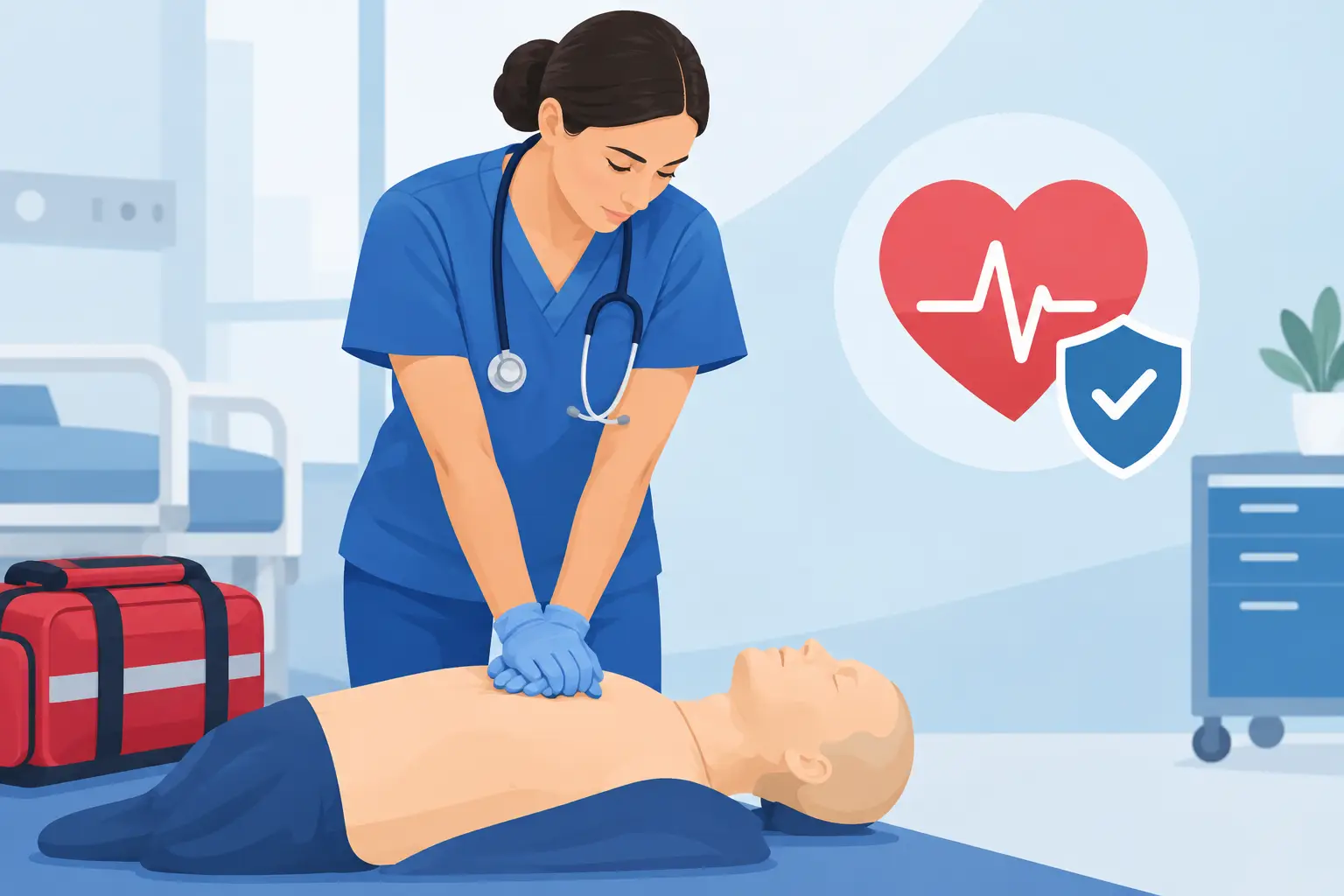
BLS Certification for Nurses and Clinical Readiness
A patient can go from talking to pulseless in seconds. In that moment, a nurse’s first actions can determine whether the room becomes organized, effective, and ready for advanced support. BLS certification for nurses is not simply a hiring requirement or a renewal date on a card. It is the foundation for recognizing arrest, starting high-quality CPR, using an AED or defibrillator as directed, and functioning with purpose until more resources arrive.
For nurses in hospitals, outpatient settings, long-term care, home health, schools, and behavioral health environments, readiness has to hold up outside a classroom. The setting, available equipment, patient population, and response team may differ. The need for prompt, competent action does not.
Why BLS certification matters in nursing practice
Basic Life Support gives nurses a common emergency-response standard. It establishes the sequence of actions used when an adult, child, or infant becomes unresponsive, is not breathing normally, or has no pulse. Just as importantly, it gives clinical teams a shared language during a high-stress event.
A nurse may be the first clinician at the bedside when a patient deteriorates. That can happen during medication administration, after a procedure, in a waiting room, during transport, or in a patient’s home. Advanced life support may be moments away, but those moments matter. Early recognition, immediate activation of the emergency response system, quality compressions, timely ventilation, and rapid defibrillation for a shockable rhythm form the chain of actions that gives a patient the best possible chance.
The certification also supports professional accountability. Many employers, clinical programs, licensing pathways, and credentialing departments require a current BLS credential from an accepted training provider. Nurses should always verify their employer’s policy before registering. A course that meets one facility’s requirement may not meet another’s, particularly when an organization specifies a particular credentialing standard or hands-on skills verification.
What nurses should be able to do after BLS training
A strong BLS course teaches more than a memorized checklist. Nurses should leave able to assess an unresponsive patient quickly, distinguish absent or abnormal breathing from normal breathing, and initiate a coordinated response without delay.
High-quality CPR remains central. That means delivering compressions at the correct rate and depth, allowing full chest recoil, limiting interruptions, and avoiding excessive ventilation. These details are not minor technique points. Compression quality directly affects blood flow to the brain and heart during cardiac arrest.
Nurses also need practical confidence with team-based resuscitation. In a clinical emergency, one person may begin compressions while another retrieves the AED, activates a code response, manages ventilation, documents events, or prepares for the arrival of the resuscitation team. Clear role assignment and closed-loop communication reduce missed steps when the room becomes crowded.
For nurses who care for pediatric patients, children and infants require particular attention. Their causes of arrest are often respiratory rather than primarily cardiac, and effective ventilation is especially significant. Training should include adult, child, and infant response skills so participants can adapt their assessment and CPR technique to the patient in front of them.
Initial certification versus renewal
New nurses, nursing students, and professionals returning to direct patient care often need an initial BLS course. Initial training should provide enough hands-on practice to build sound mechanics before a skills evaluation. Learners benefit from instructor feedback on compression depth, hand placement, recoil, ventilation, AED pad placement, and response sequence.
Renewal is different, but it should not become casual. Experienced nurses may know the material well, yet skills can drift over time. People compress too shallowly, pause too long, lose track of ventilation timing, or rely on assumptions about a device they have not recently used. A renewal course is an opportunity to correct those habits before an actual emergency exposes them.
The right course length depends on experience and the training format, but the standard should remain the same: participants must demonstrate the required skills, not simply watch a video or complete questions online. Nurses work in hands-on environments. Their training should require hands-on performance.
Choosing a BLS course that fits your role
Before scheduling, start with your employer, school, or agency requirement. Ask which credential is accepted, when it must be completed, whether a blended option is allowed, and whether the facility has additional orientation or skills expectations. Do not wait until the expiration date is days away. Scheduling pressure creates avoidable gaps in compliance and can affect shifts, clinical placement, or onboarding.
Then consider the quality of the instruction. A credible BLS course should include practical skills practice, objective evaluation, and instructors who can explain how the protocol applies when conditions are less than ideal. EMS-informed instruction is especially valuable because it brings field-tested awareness of scene control, rapid assessment, teamwork, and communication under pressure.
Convenience matters, particularly for nurses balancing long shifts and family responsibilities. It should not come at the expense of skill development. The best option is one that meets the required standard, offers clear scheduling, and provides sufficient practice to perform confidently.
BLS certification for nurses in different settings
The core response sequence is consistent, but nursing environments create different operational challenges. A medical-surgical nurse may need to recognize subtle deterioration and call a rapid response before arrest occurs. An emergency nurse may enter an active resuscitation and take a defined role immediately. A home-health nurse may be the only clinician present, responsible for calling 911, beginning care, and directing family members until EMS arrives.
Long-term care and rehabilitation teams may respond with fewer staff immediately available. School nurses may have limited adult assistance and must manage both the patient and bystanders. Outpatient and procedural nurses must know where emergency equipment is stored and how their facility activates help. In every case, BLS training becomes more useful when it is reinforced by site-specific drills and a clear understanding of local emergency protocols.
That is why organizations should not treat group certification as a box-checking event. Training 10 or more staff members together can strengthen team coordination, especially when the session reflects the equipment, staffing patterns, and likely emergencies of the workplace. On-site training can also limit disruption to operations while allowing teams to practice in a familiar environment.
How to retain skills between certification dates
Certification is periodic. Readiness is ongoing. Nurses can maintain stronger response habits by locating emergency equipment at the start of a new assignment, reviewing their unit’s code procedure, and participating fully in mock codes and post-event debriefings.
Short, repeated practice is often more valuable than relying on memory from a course taken years earlier. Use simulation opportunities to rehearse role assignments, compressor changes, AED setup, ventilation support, and communication. Ask direct questions after drills: Who calls for help? Who brings the crash cart? Where are pediatric pads? What changes after hours?
Leaders have a responsibility here as well. A current card does not guarantee a prepared team if staff do not know their facility’s emergency workflow. Nurse managers, educators, and operational leaders should make training accessible, track upcoming expirations, and create realistic opportunities for staff to practice together.
The standard is competent action
No nurse expects to encounter a cardiac arrest during an ordinary shift. Yet emergencies do not wait for the convenient moment, the fully staffed unit, or the perfect clinical setting. When a patient collapses, the first minutes demand calm assessment, disciplined technique, and teamwork.
BLS Updates approaches certification with that reality in mind: preparedness is a responsibility, not just a card. Keep your credential current, but also protect the skill behind it. The patient in front of you will not need proof that you attended a class. They will need a nurse ready to act.
Comments