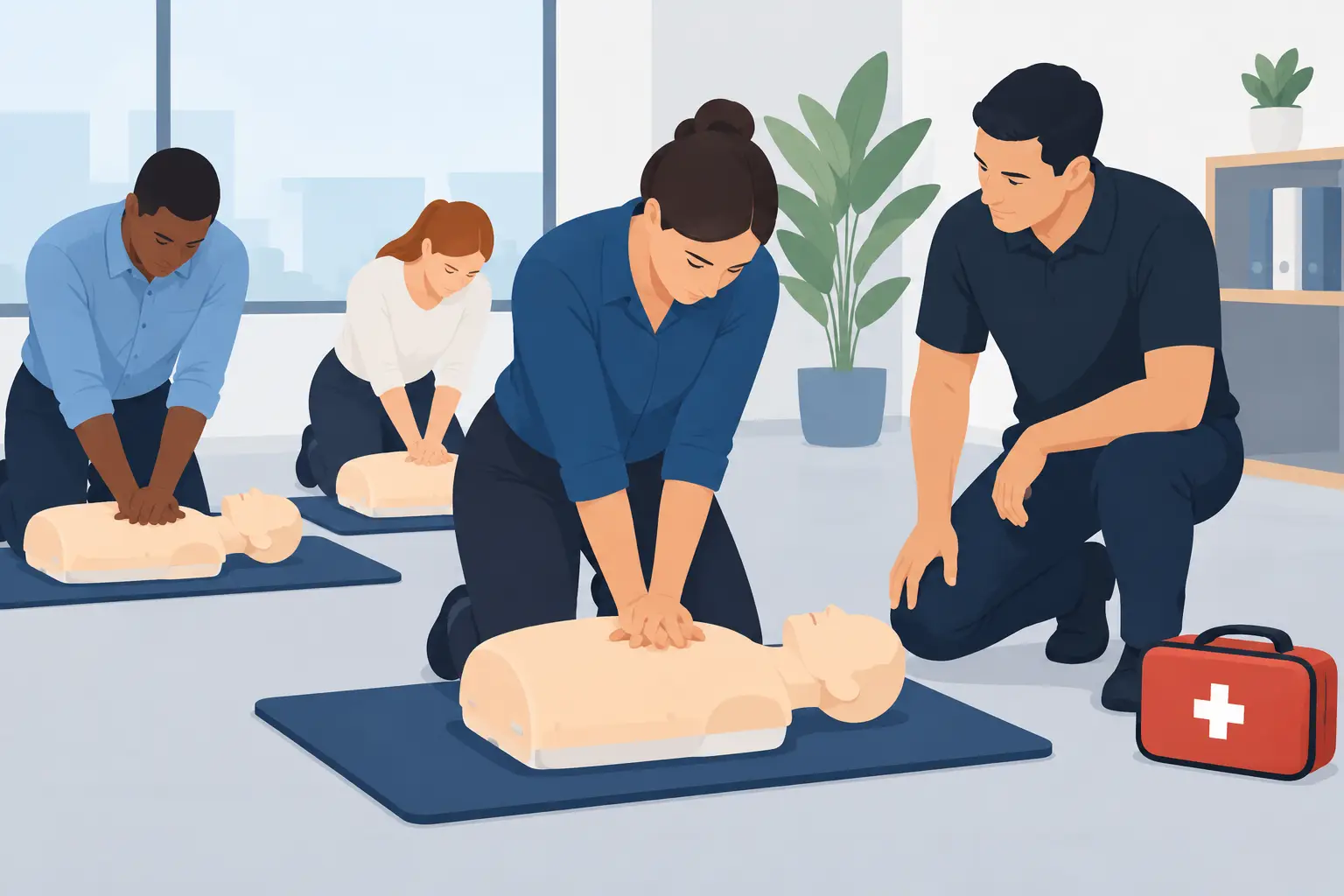
Workplace CPR Training That Prepares Teams to Act
A coworker collapses in the break room. A visitor becomes unresponsive at the front desk. A child at a school event suddenly stops breathing. In those first minutes, workplace CPR training determines whether people freeze, wait for help, or recognize the emergency, call 911, bring the AED, and begin effective care.
Preparedness is not a poster in the hallway or a certification card in a personnel file. It is the ability of real people, in a real workplace, to take the next right action under pressure. For healthcare teams, that standard is central to patient safety. For schools, churches, offices, long-term care settings, sports organizations, and public-facing businesses, it is part of the duty owed to staff, visitors, and the community.
Why Workplace CPR Training Is an Operational Need
Cardiac arrest can happen anywhere, and emergency medical services cannot be in the room when it starts. Bystanders are the bridge between collapse and advanced care. Early recognition, activation of emergency response, high-quality chest compressions, and prompt AED use can make a critical difference.
That reality changes how organizations should view CPR instruction. The goal is not simply to meet a policy requirement. The goal is to create a response system that works when a person is frightened, the scene is busy, and every second feels longer than it should.
For clinical teams, Basic Life Support training reinforces a coordinated response: recognizing arrest, delivering quality compressions, ventilating appropriately, using an AED or defibrillator, and communicating within a team. For nonclinical workplaces, community CPR instruction can give staff the practical confidence to respond before professional responders arrive. The right course depends on job roles, regulatory requirements, and the people an organization serves.
A daycare, for example, needs staff prepared for adult, child, and infant emergencies. A nursing home may need a plan that accounts for vulnerable residents, shift coverage, and coordination with clinical personnel. An office may focus on adult CPR, AED access, and clear emergency activation procedures. One course format does not fit every operation.
Build a Training Plan Around Your Actual Risks
Effective workplace CPR training starts with an honest look at the environment. Leaders should consider who is present each day, where an emergency could occur, what equipment is available, and who is expected to act before EMS arrives.
Start with staffing. Training only one designated responder per shift creates a fragile plan. People take breaks, work remotely, call out, travel, or may be the person experiencing the emergency. A stronger approach trains enough employees across departments and schedules so that trained responders are likely to be nearby at any time.
Next, evaluate your population. An outpatient clinic, home-health agency, warehouse, church, school, and recreation program do not face identical risks. Consider the ages of patients or participants, the physical demands of the setting, known medical vulnerabilities, and the likelihood of a delayed EMS response. These factors help determine whether staff need professional-level BLS credentials, general CPR education, first aid instruction, or a combination of training.
Equipment matters, but equipment alone is not a plan. If an AED is available, employees must know its location, how to retrieve it, who calls 911, and how to use it without delaying compressions. The device provides clear prompts, yet the workplace still needs people willing to act. Training should make the AED familiar before a crisis occurs.
Define Roles Before the Emergency
In a small office, one person may call 911 while another begins CPR and a third retrieves the AED. In a hospital or care facility, roles may be more structured, with a team leader, compressor, airway support, medication support, and recorder. Either way, people should understand their responsibilities before someone collapses.
A simple internal response plan should answer practical questions: Who contacts emergency services? Who meets responders at the entrance? Where is the AED? Who takes over compressions if the first responder tires? What happens after the event? These details reduce confusion when clear thinking is hardest.
Hands-On Skills Are the Standard
Watching a video or answering online questions may support learning, but it does not replace skill practice when learners are expected to perform CPR. Chest compression depth, rate, recoil, hand position, ventilation technique, and AED operation require physical repetition and instructor feedback.
During a quality course, participants should practice responding to realistic scenarios, not merely repeat terminology. They should work through an unresponsive adult, identify when to send someone for an AED, perform compressions on a manikin, apply pads, and continue care while communicating with others. When appropriate to the course audience, they should also practice child and infant CPR.
That practice exposes common problems early. Some participants compress too slowly. Others do not allow full chest recoil, hesitate to use the AED, or stop compressions for too long while waiting for instructions. These are correctable issues in training. In an actual emergency, they can cost valuable time.
Experienced EMS-informed instructors add practical value because they can connect the lesson to field realities. They can explain why clear commands matter, why responders should rotate during prolonged CPR, and why doing something imperfectly but promptly is often better than standing back while waiting for the “right” person to arrive.
Schedule Training Without Disrupting Care or Operations
Organizations often postpone training because scheduling appears complicated. That concern is understandable, especially for facilities with shift work, patient care demands, seasonal staffing, or multiple locations. The answer is not to lower the standard. It is to plan training around the operation.
On-site group instruction can reduce travel time and help teams train in the environment where they will respond. Smaller sessions across shifts may work better than pulling an entire department away at once. For teams of 10 or more, a custom training plan can align course content, participant volume, and scheduling needs without treating the group as a collection of individual bookings.
Leaders should also track expiration dates before they become urgent. Renewal training is more manageable when it is scheduled well ahead of credential deadlines. A centralized roster helps managers identify who needs initial certification, who needs renewal, and which departments have thin coverage.
Do Not Let Certification Become the Finish Line
A valid card matters when a role, employer, accrediting body, or licensing requirement calls for it. But certification alone does not guarantee an effective response months later. Skills decay, staff turnover changes coverage, and equipment locations get forgotten.
The organizations that stay ready build brief reinforcement into normal operations. They review AED locations during orientation. They include emergency procedures in shift huddles or safety meetings. They check that AED cabinets are accessible and that supplies are maintained according to the manufacturer’s requirements. They revisit who will guide EMS into the building.
A short scenario discussion can be useful: “A visitor collapses near the loading dock. Who calls 911? Which entrance should EMS use? Where is the nearest AED?” These conversations are not a substitute for formal training, but they turn knowledge into an operational habit.
After any actual emergency, leaders should also conduct a respectful review. The purpose is not to assign blame. It is to identify what supported the response and what created delay, then improve the plan while details are still clear.
Choose Training That Fits the Responsibility
When selecting a provider, look beyond the calendar and price. Confirm that the course meets the credential requirements for the participants’ roles, includes the necessary hands-on evaluation, and covers the age groups relevant to your setting. Ask how the instructor handles team response, AED practice, and real-world questions from your staff.
For healthcare professionals and those entering healthcare, BLS instruction should reflect the pace and coordination expected in clinical emergencies. For community groups and nonclinical teams, the course should be accessible without being watered down. Every participant should leave knowing how to recognize an emergency, activate help, start CPR, and use available equipment.
BLS Updates delivers hands-on instruction designed around that standard: competent action, clear judgment, and confidence under pressure. The value of training is measured when someone needs help and the people nearby know what to do.
The best time to build that readiness is before the call for help, before the AED cabinet opens, and before a coworker looks around the room hoping someone will step forward. Prepared people save lives.
Comments