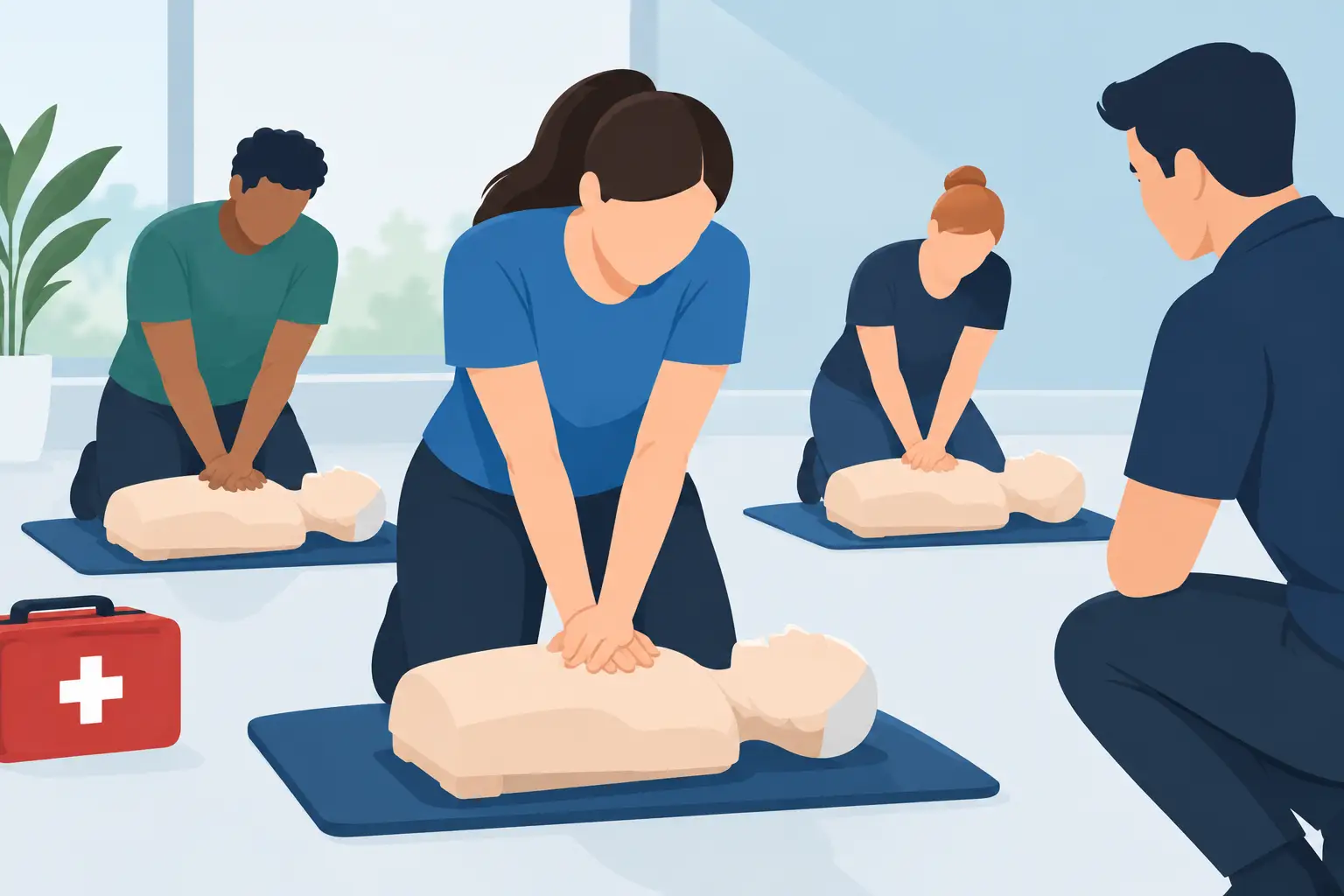
Why Hands On CPR Classes Build Real Readiness
A person collapses at work, a child becomes unresponsive at home, or a patient deteriorates before the response team arrives. In those first moments, nobody benefits from vague recollection of an online module. Hands on CPR classes prepare people to recognize an emergency, begin effective care, use available equipment, and work with others under pressure.
A certification card may be required for a role. Competent action is required when a life is on the line. The difference is practice.
Why hands on CPR classes matter
CPR is a physical skill performed in an unpredictable environment. A responder must position a person safely, locate the correct hand placement, compress at an appropriate rate and depth, allow full chest recoil, manage ventilation when indicated, and minimize interruptions. Those actions are difficult to judge from a screen alone.
Hands-on instruction gives participants direct feedback while the skill is being performed. An instructor can identify shallow compressions, incorrect body mechanics, prolonged pauses, poor seal during rescue breaths, or hesitation with an AED. Correcting those issues in the room creates muscle memory that written tests cannot measure.
Practice also changes how people respond emotionally. Emergencies are loud, fast, and often frightening. A learner who has worked through a realistic scenario is more likely to move with purpose: check for responsiveness, call for help, direct someone to bring the AED, and begin care. Training does not remove the stress of a real emergency, but it gives stress a clear procedure to follow.
For healthcare professionals, this is especially important. BLS responsibilities often include team-based response, rapid patient assessment, high-quality compressions, ventilation support, and effective communication until additional resources arrive. Renewal training should reinforce performance standards, not simply confirm that a credential has not expired.
What practical CPR training looks like
A quality class is structured around doing the work, receiving coaching, and doing it again. Participants learn the sequence, but they also learn what competent performance feels like.
Adult, child, and infant skills are not interchangeable
The core purpose of CPR is consistent: provide circulation and support breathing during cardiac arrest until advanced care is available. The technique, however, changes with the patient. Adult compressions require a different approach than compressions for a child or infant. Airway positioning, rescue breaths, and the use of AED pads may also vary by age and equipment.
Hands-on practice lets learners move through those differences with instructor oversight. Community members may need the confidence to respond to a family emergency. Daycare teams need skills relevant to infants and children. Healthcare personnel need to perform to the standards expected in clinical settings. A course should match the actual people a participant is likely to serve.
The AED should be part of the practice
An AED is designed to guide users, but it still must be retrieved, powered on, applied correctly, and integrated into CPR with minimal delay. During a real event, even a simple device can feel unfamiliar if it has only been discussed.
Practical training teaches participants to continue coordinated care while the AED is prepared, clear the patient when instructed, and immediately resume compressions after analysis or shock delivery. The goal is not to memorize every device model. It is to develop a reliable response pattern that works when seconds matter.
Scenarios reveal the gaps that lectures miss
A strong class includes scenarios because emergencies rarely arrive as clean, quiet demonstrations. One person may be calling 911 while another begins compressions. Someone may need to locate the AED. A team may have to rotate compressors before fatigue reduces quality.
These exercises expose common breakdowns: unclear roles, delayed communication, failure to call for additional help, or compressions that become less effective over time. They also teach a critical operational habit: speak plainly. “You call 911.” “Bring the AED.” “You take over compressions.” Clear direction prevents capable people from standing still because they assume someone else is acting.
Feedback is where confidence becomes competence
Many people leave a CPR class saying they feel more confident. That is valuable, but confidence must be connected to correct technique. A learner who feels assured while delivering ineffective compressions has not been adequately prepared.
Instructors with EMS experience understand the difference between explaining a skill and coaching performance. They can help participants adjust posture, use body weight rather than arm strength, maintain rhythm, and protect quality as fatigue sets in. They can also explain why each standard matters in a way that connects directly to patient care.
The best feedback is specific and immediate. Rather than hearing “good job” after a full scenario, participants should know what to maintain and what to correct in the moment. A small adjustment in hand placement or compression depth can materially improve performance. Repetition then turns that correction into a habit.
This is also why a class should allow enough time for each learner to practice. Large groups can be efficient, but efficiency should not come at the cost of meaningful skill time. For organizational training, the right format depends on staff count, shift schedules, role requirements, and the number of instructors needed to keep practice active.
Choosing hands on CPR classes for your role
The right course is not always the longest course or the most convenient one. It is the course that meets the credential requirement and prepares the learner for the emergencies their role may involve.
Healthcare workers, EMS personnel, nursing students, home-health professionals, and other clinical staff generally need BLS training that addresses professional standards and team response. New entrants may need an initial BLS course, while experienced professionals approaching expiration need a renewal course that still includes meaningful skills verification.
Community learners may be best served by CPR instruction focused on adult, child, and infant emergencies, plus AED use and the confidence to activate emergency services. Parents, coaches, church safety teams, teachers, and workplace staff all benefit from training that reflects the environments where they spend their time.
When evaluating a provider, ask whether the course includes in-person skills practice, instructor feedback, adult, child, and infant content where appropriate, AED training, and legitimate certification for the intended role. For professional settings, also ask how the training handles scheduling, documentation, class size, and operational disruption.
At BLS Updates, practical instruction is built around real-world response, with training options for BLS initial certification, BLS renewal, community CPR, and custom on-site programs for teams of 10 or more.
Prepared teams respond faster
For hospitals, nursing homes, schools, daycares, churches, and businesses, CPR training is not only an individual responsibility. It is part of the organization’s readiness plan. A trained employee still needs clear emergency procedures, accessible AEDs, defined communication pathways, and coworkers who understand their roles.
On-site group training can strengthen that plan because it places people who work together in the same learning environment. Teams can practice handoffs, assign roles, and identify practical barriers before an emergency exposes them. A school may need to account for building access and staff coverage. A nursing facility may focus on rapid response around residents with complex needs. A church safety team may need to coordinate care until EMS arrives.
There is a trade-off: customized training requires planning, and taking staff out of normal duties requires coordination. The alternative is trying to organize a response for the first time during a crisis. For leaders responsible for others, that is not a reasonable standard.
Keep skills from fading after class
Certification has an expiration date, but skill decline can begin much sooner without use. Teams should periodically review where AEDs are located, who calls emergency services, who meets responders, and how staff communicate during an incident. Brief scenario discussions can keep procedures familiar without replacing formal recertification.
Individuals can reinforce readiness by reviewing the response sequence, noticing AED locations in workplaces and public spaces, and signing up for renewal before credentials lapse. If a technique feels uncertain, ask for additional practice. There is no value in protecting pride when a patient may later depend on your ability to act.
The moment someone becomes unresponsive is not the time to wonder whether you remember what to do. Train with your hands, practice with your team, and carry the responsibility of readiness into every place people depend on you.
Comments