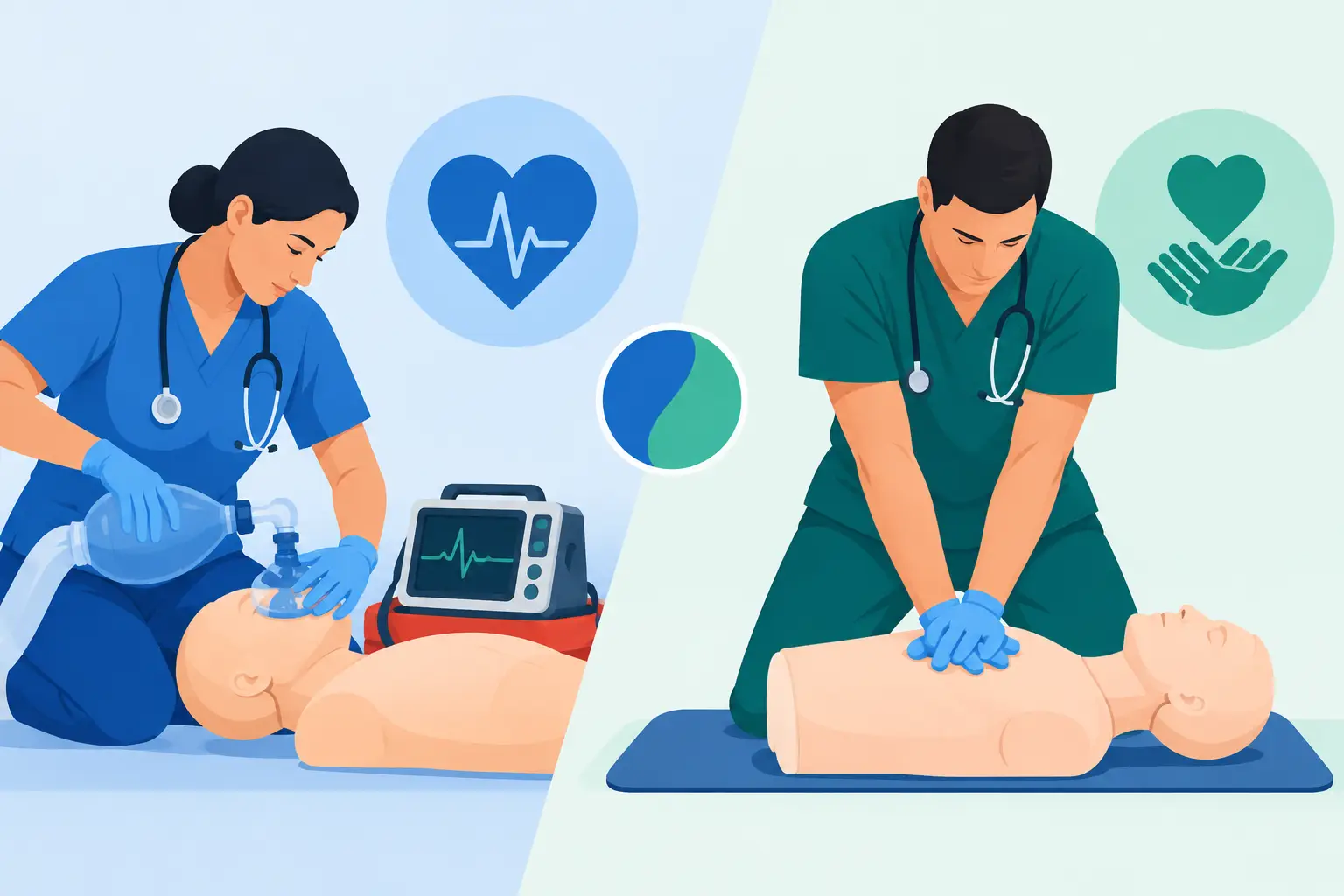
BLS vs CPR Certification for Healthcare Roles
A cardiac arrest does not wait for a convenient moment, a fully staffed unit, or a written test. The difference between BLS vs CPR certification matters because the training must match the responsibilities a responder will carry when a life is on the line. For some people, a community CPR course provides the skills they need to act. For healthcare and public-safety professionals, BLS is often the required clinical standard.
The right choice is not about selecting the more impressive card. It is about being prepared for the environment where you work, the people you serve, and the emergency protocols your organization expects you to follow.
What CPR Certification Typically Covers
CPR certification teaches a lay responder how to recognize a cardiac emergency, call for help, begin high-quality chest compressions, deliver rescue breaths when included in the curriculum, and use an automated external defibrillator, or AED. Many community CPR courses also address choking emergencies and provide instruction for adults, children, and infants.
This training is essential. A family member, coach, teacher, childcare provider, church safety volunteer, or workplace employee may be the first person available when someone collapses. Their ability to start CPR, retrieve an AED, and keep care moving until EMS arrives can change the outcome.
Community CPR training is generally designed for people who do not work in clinical settings. The instruction emphasizes clear decision-making: recognize the emergency, activate 911, start compressions, use the AED, and continue until professional responders take over. It gives everyday responders practical skills without requiring them to function as part of a coordinated medical team.
That distinction matters. CPR is a core skill within BLS, but CPR certification and BLS certification are not always interchangeable credentials.
What BLS Certification Adds
Basic Life Support, or BLS, is designed for healthcare professionals and other trained responders who may need to provide care in clinical, prehospital, or professional settings. It includes high-quality CPR, AED use, rescue breathing, and relief of choking, but it goes further in how those skills are performed.
BLS training focuses on coordinated response. Participants practice working as part of a team, assigning roles, minimizing pauses in chest compressions, communicating clearly, and switching compressors before fatigue reduces compression quality. These are not minor details. During cardiac arrest, organized team performance directly supports continuous, effective resuscitation.
A BLS course may also place greater emphasis on clinical judgment within the responder's role, including rapid assessment, use of barrier devices, bag-mask ventilation, and response to adult, child, and infant emergencies. The exact skills taught can vary by course provider and credentialing organization, but the purpose remains consistent: prepare professional responders to deliver competent, team-based basic life support.
For nurses, medical assistants, EMTs, paramedics, physicians, home-health staff, dental teams, hospital employees, and many healthcare students, BLS is commonly required by employers, clinical sites, licensing programs, or professional schools. If an application, job description, or compliance policy says “BLS for Healthcare Providers” or specifies an approved credentialing organization, a general CPR card may not meet the requirement.
BLS vs CPR Certification: The Practical Difference
The simplest way to understand BLS vs CPR certification is to consider the setting and level of responsibility.
CPR certification prepares a nonclinical responder to act quickly and effectively before EMS arrives. BLS certification prepares a professional responder to perform those same lifesaving skills within a more structured, often team-based response. Both can include adult, child, and infant care. Both can teach AED use. The difference is the depth of training, the expected role of the learner, and the credential an employer or organization recognizes.
A daycare director may need staff members trained in pediatric CPR and emergency response. A church safety team may need adult, child, and infant CPR skills, AED practice, and a response plan that works in a large gathering. A nursing student beginning clinical rotations may need BLS because the clinical site requires it. An experienced respiratory therapist renewing an expiring card needs the credential their employer accepts, not simply a course with CPR in its title.
No course title should be treated as a substitute for checking the requirement. Before registering, read the exact language from your employer, school, licensing board, clinical placement, or organization policy. Ask whether a specific provider is required, whether an in-person skills evaluation is necessary, and whether a blended course format is accepted. A card that does not meet the stated standard can delay onboarding, clinical access, or compliance.
Who Should Choose BLS?
BLS is generally the appropriate path for people whose jobs place them within the healthcare or public-safety response system. That includes hospital staff, nurses, EMS personnel, physicians, dental professionals, medical office teams, home-health workers, allied health students, and caregivers whose employers specifically require BLS.
It may also be the right choice for organizations building a higher level of readiness. A school nurse team, healthcare-adjacent workplace, sports medicine staff, or security group may benefit from BLS-level training when their response plans require coordinated care before EMS arrival. However, organizations should not assume that BLS is automatically necessary for every employee. The best program balances the real risks of the setting, staff roles, regulatory requirements, and the level of care personnel are authorized to provide.
For teams of 10 or more, on-site instruction can reduce scheduling disruption while allowing training scenarios to reflect the actual workplace. Practicing an emergency response in the room, gym, sanctuary, clinic, or office where it could occur helps participants identify practical issues: where the AED is stored, who calls 911, who meets EMS at the entrance, and how communication will work under pressure.
Who Should Choose CPR Certification?
CPR certification is a strong fit for community members and nonclinical teams who want the confidence to act during an emergency. Parents, grandparents, coaches, teachers, childcare staff, fitness professionals, church volunteers, workplace safety teams, and youth program leaders all benefit from hands-on CPR and AED training.
The value is not limited to formal requirements. Cardiac emergencies occur at home, at work, in schools, and in public spaces. A trained bystander who starts CPR immediately can provide critical care in the minutes before EMS arrives.
For many organizations, community CPR training is the practical choice because it builds broad readiness without assigning clinical responsibilities that employees do not hold. The course should still include hands-on practice. Watching a video or passing an online quiz does not create the same muscle memory as placing hands correctly, finding the right compression depth and rate, using a training AED, and practicing a response sequence under instructor guidance.
Initial Certification, Renewal, and Expired Cards
Whether you need BLS or CPR, confirm whether you are registering for an initial course or a renewal. Renewal courses are intended for people with a current, eligible credential and prior training experience. If your card has expired, your employer or course provider may require an initial course instead.
Do not wait until the week your credential expires. Scheduling pressure can lead people to choose an unaccepted course format or a provider that does not meet workplace standards. Give yourself enough time to verify requirements, complete the class, receive documentation, and resolve any compliance questions before a deadline affects your work schedule.
Skill retention deserves the same attention. Certification periods may last for years, but emergency skills are perishable. Responders who practice realistic scenarios, refresh their knowledge, and understand their organization's emergency plan are more likely to move decisively when an event occurs.
Choose the Credential Your Responsibility Requires
The correct credential is the one that prepares you for the role you are expected to perform and satisfies the standard your workplace recognizes. For healthcare and public-safety professionals, that is often BLS. For families, community members, and many nonclinical workplaces, CPR certification may provide the right level of preparation.
At BLS Updates, training is built around hands-on practice and EMS-informed scenarios because preparedness is a responsibility, not just a card. Choose the course that fits your role, then treat every practice compression, AED prompt, and team communication drill as preparation for a real person who may need you to act.
Comments