How Often Do You Renew BLS Certification?
A BLS card can expire on an ordinary workday. The emergency it prepares you for will not wait for a convenient time. If you are asking, how often do you renew BLS certification, the standard answer is every two years. But the date on your card is only the starting point. Your employer’s policy, the credentialing body, and your role can all affect when you need to complete training.
For nurses, EMS professionals, home-health staff, medical assistants, and healthcare students, renewal is part of maintaining readiness. For leaders scheduling teams, it is a compliance deadline with direct consequences for staffing, credentialing, and patient safety. Plan early enough that your certification never becomes the reason someone cannot work, respond, or meet a clinical requirement.
How Often Do You Renew BLS Certification?
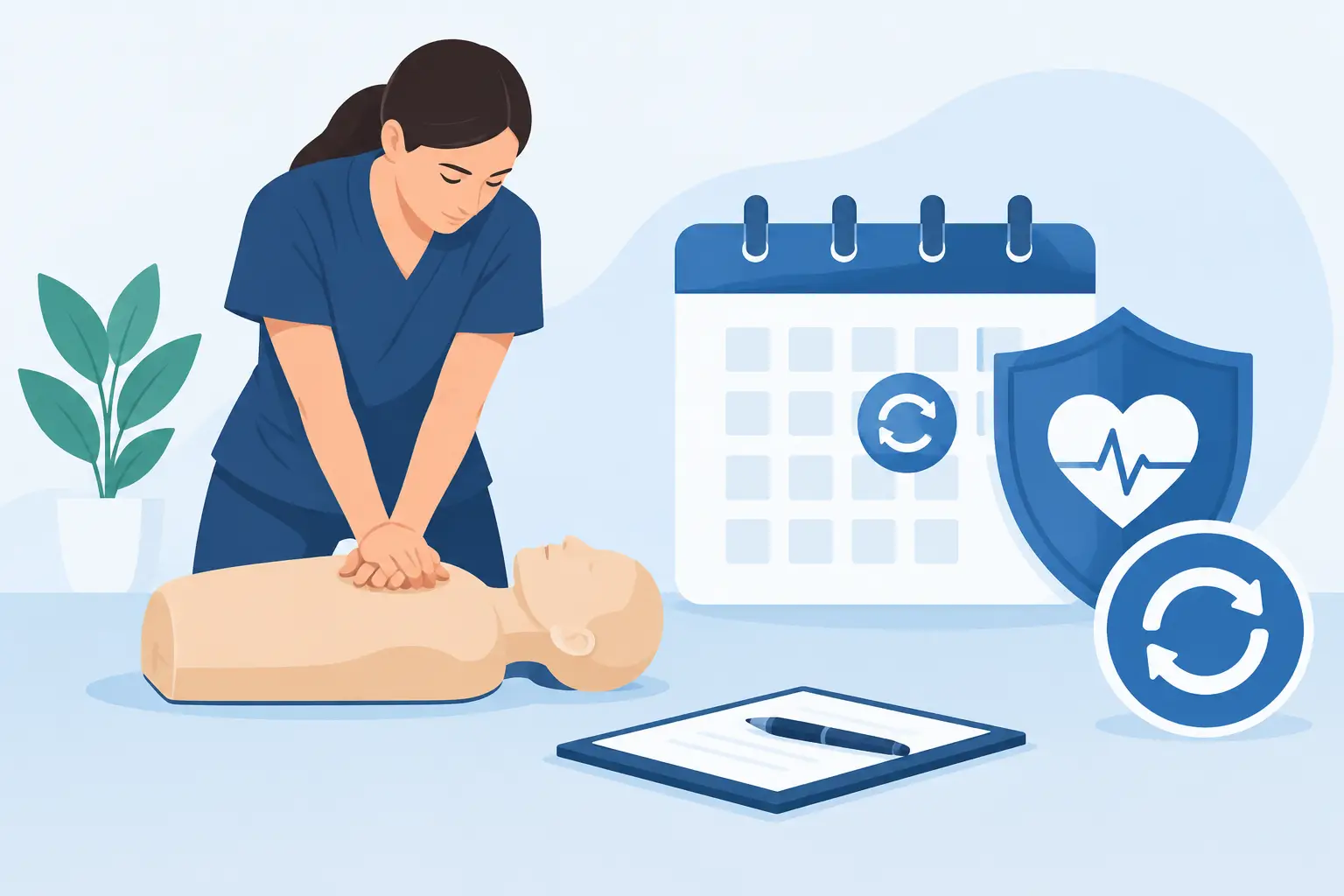
Most nationally recognized Basic Life Support certifications are valid for two years from the date of course completion. Before that two-year period ends, complete a qualifying BLS renewal or recertification course to maintain an active credential.
That two-year cycle is widely used because BLS is a hands-on skill set, not information meant to be stored away after one class. High-quality CPR, team communication, AED use, ventilation, and response to adult, child, and infant emergencies require practice. Research and field experience both show that psychomotor skills can decline when they are not used or refreshed.
Your card should show an issue date and expiration date. Use the expiration date as your operational deadline, but do not wait until that week to act. Course availability, shift schedules, travel, illness, or employer approval can turn a simple renewal into an avoidable credentialing problem.
The Two-Year Rule Has Important Exceptions
Two years is the standard, not a substitute for reading your workplace requirements. A hospital, EMS agency, nursing facility, school district, or clinical program may require you to renew well before the card’s expiration date. Some organizations need updated documentation in their system before a credential expires, not after.
A few situations deserve special attention.
Your employer may set an earlier deadline
Healthcare employers often build renewal deadlines into their compliance systems. They may ask for your new card 30, 60, or 90 days before expiration so there is time to verify the credential. If you work through a staffing agency, maintain privileges at more than one facility, or rotate through clinical sites, the earliest requirement may be the one that controls your schedule.
Do not assume that an active card is enough if the facility requires a specific provider, format, or course designation. Ask whether it accepts the credentialing organization you plan to use and whether the course must include a live, hands-on skills evaluation.
Your certifying organization determines course eligibility
Not every CPR class meets the BLS requirement for healthcare professionals. Community CPR is valuable training, but it may not satisfy a hospital’s BLS credentialing standard. BLS renewal courses are designed for providers who need professional-level CPR training, including team dynamics, use of a bag-mask device, and response protocols relevant to clinical settings.
If your existing credential is from a particular national organization, verify whether your employer requires renewal through that same organization or accepts an equivalent recognized course. The correct class is the one that meets your employer, licensing, school, or agency requirement - not simply the fastest available option.
Expired cards are different from cards nearing expiration
Many course providers use the word “renewal” for participants whose cards are still current or only recently expired. However, there is no universal grace period that guarantees your employer will treat an expired card as active. The moment the card expires, your workplace may remove you from patient-facing duties, suspend a credential, or require a different enrollment process.
If your card has already expired, contact your employer or program administrator immediately. You may still be able to take a renewal-format class depending on the provider’s rules, but you should not assume you are cleared to work until the new credential is issued and accepted.
When Should You Schedule BLS Renewal?
A practical rule is to schedule BLS renewal 30 to 60 days before expiration. This gives you room to reschedule if a shift changes, a course fills, or your organization needs additional documentation. For professionals with rigid compliance rules, begin checking dates 90 days out.
The best timing also depends on your work environment. An ICU nurse with annual competency reviews may need a different schedule than a home-health aide, student, or church safety-team member. The credential expiration date remains the hard boundary, but organizational processes often create an earlier real-world deadline.
For individual learners, add the expiration date to your calendar with reminders at 90, 60, and 30 days. Keep a digital copy of your card in a secure location where you can send it quickly to an employer or school. For managers, maintain a centralized expiration tracker and review it monthly. Waiting until several staff members are within two weeks of expiration creates unnecessary scheduling pressure.
What a Proper BLS Renewal Should Reinforce
Renewal is not supposed to be a card transaction. It is an opportunity to correct technique before the next emergency places a patient, coworker, student, or family member in front of you.
A credible BLS renewal course should include hands-on practice and evaluation. Participants should perform high-quality adult, child, and infant CPR; use an AED; practice rescue breathing and bag-mask ventilation when required; and work through choking and team-response scenarios. Healthcare providers should also review how to recognize deterioration, communicate clearly, and assume roles during a coordinated resuscitation.
The details matter. Compression depth, rate, recoil, ventilation quality, AED pad placement, and minimizing interruptions can affect outcomes. So can the human factors: calling for help early, assigning tasks, speaking with clarity, and recognizing when a team member needs direction. A renewal course should leave you more prepared to act, not merely more certain that your card has a new date.
That is why hands-on instruction led by experienced emergency responders has value. It connects the standard to the pressure of real response. At BLS Updates, practical scenario training is built around that expectation: preparedness is a responsibility, not just a card.
Renewal for Teams and Organizations
For organizations, BLS renewal is a readiness system. A missed expiration can create coverage gaps, compliance exposure, and last-minute overtime. A well-managed program protects operations while giving staff enough time to practice the skills they may need without warning.
Start by grouping employees according to expiration month and role. Stagger training where possible so an entire unit is not out of compliance at once. For teams of 10 or more, on-site instruction can reduce travel, simplify attendance tracking, and minimize disruption to patient care or daily operations.
Leaders should also confirm who actually needs BLS versus a community CPR course. Clinical staff and many public-safety personnel commonly need BLS. Teachers, childcare workers, coaches, church safety teams, and office personnel may have different requirements based on their employer, licensing rules, or assigned duties. Training everyone to the appropriate level is more useful than applying one credential indiscriminately.
Common Renewal Mistakes to Avoid
The most common mistake is waiting until expiration week. The second is enrolling in a class that does not meet the employer’s requirements. Both are preventable with a quick review of the card, workplace policy, and accepted credentialing standards.
Also avoid treating online coursework alone as automatically sufficient. Some employers accept blended learning, where online instruction is followed by an in-person skills session. Others require a fully instructor-led course. A completion certificate is not automatically the same as an approved BLS credential, particularly when hands-on skills verification is required.
Finally, do not let familiarity reduce your attention. Experienced professionals can be especially tempted to see renewal as routine. Experience is valuable, but protocols evolve and skills can drift. The purpose of recertification is to bring performance back to a measurable standard before an emergency tests it.
Your BLS certification should be renewed every two years, preferably well before the printed expiration date. Put the date on your calendar, confirm the course meets your workplace requirements, and use the class to practice with purpose. When the call for help comes, readiness is measured by what you can do in the first critical minutes.
Comments