What a BLS Initial Certification Course Prepares You For
A BLS initial certification course is not simply a requirement to check off before a new job, clinical rotation, or credentialing deadline. It is preparation for the moment a patient, coworker, visitor, or family member suddenly becomes unresponsive and the first few actions determine what happens next. The goal is clear: recognize the emergency, begin effective care, use available equipment, and work as part of a coordinated response.
For healthcare entrants and professionals new to a BLS requirement, the course establishes the clinical foundation behind high-quality cardiopulmonary resuscitation. For organizations, it creates a more consistent response standard across staff members who may be first on scene before the full emergency team arrives.
Who Needs a BLS Initial Certification Course?
Initial BLS training is generally for learners receiving BLS credentials for the first time or for those whose prior credential has expired beyond an accepted renewal window. It is common for nursing students, medical assistants, home-health workers, dental teams, patient care technicians, EMT candidates, and newly hired healthcare personnel.
The course can also be appropriate for school health staff, daycare personnel, church safety teams, athletic programs, and workplace responders when their role requires a healthcare-level CPR credential or a higher level of hands-on preparation. Employer requirements vary. Before enrolling, confirm the credential required by your hospital, school, licensing board, clinical program, or agency.
That distinction matters. A community CPR class can be an excellent option for parents, coaches, and general workplace learners, but it may not meet a healthcare employer’s BLS requirement. A legitimate BLS course should clearly state what credential is issued, how long it remains valid, and whether your employer accepts it.
What You Will Learn in Initial BLS Training
BLS training is built around decisive action under pressure. Learners practice how to assess a collapsed or unresponsive person, activate emergency response, start CPR promptly, and continue care until additional help takes over.
A quality class covers adult, child, and infant emergencies because the patient, environment, and response can change quickly. A nurse may respond to an adult visitor in a waiting room, while a daycare provider may need to recognize a child or infant emergency. The core principles of rapid recognition, early CPR, and fast defibrillation remain consistent, but the techniques must fit the patient.
High-Quality CPR Is a Physical Skill
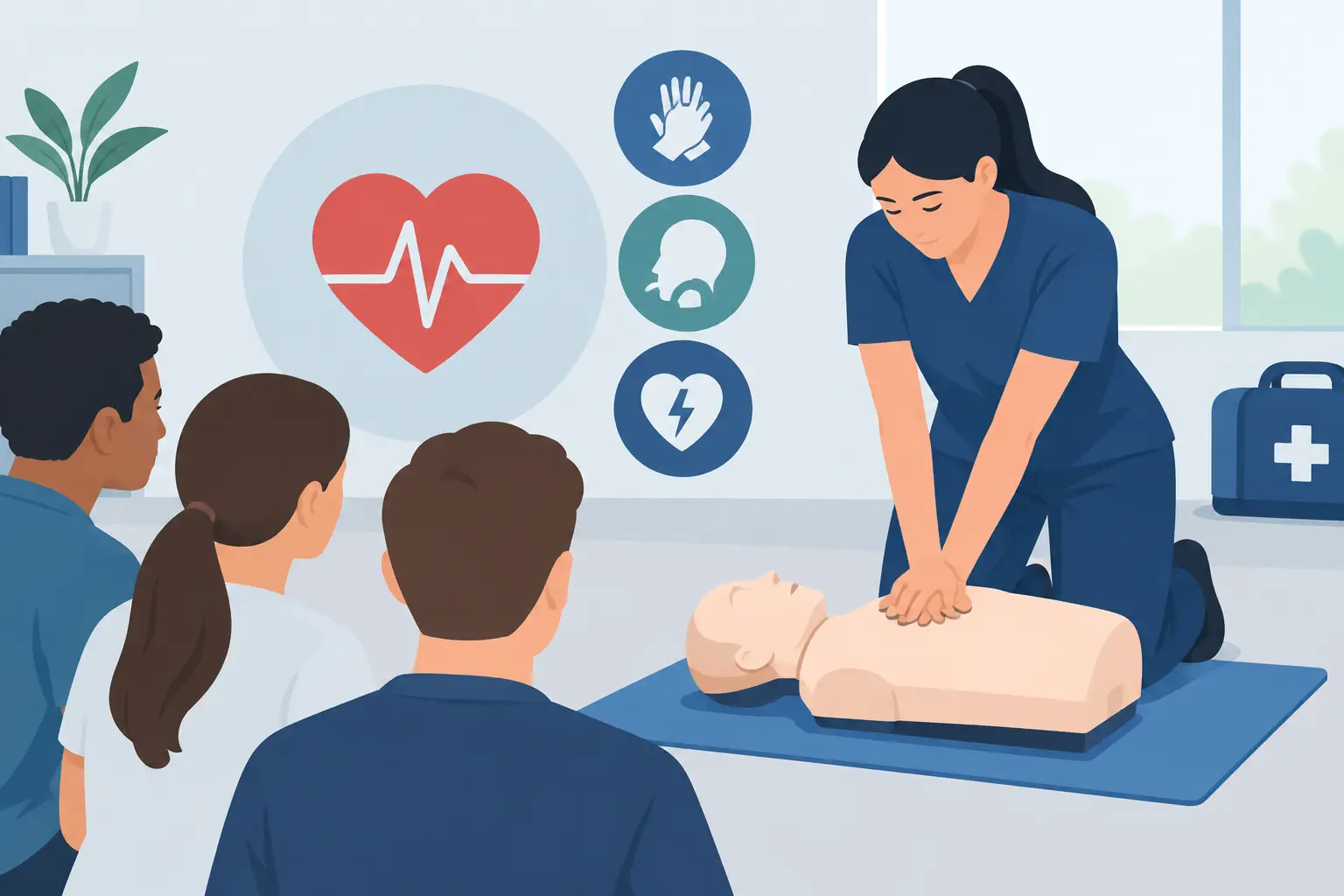
CPR cannot be learned well by watching slides alone. Participants need repeated, coached practice on manikins so they can develop correct hand placement, compression depth, rate, recoil, and ventilation technique. Small errors can reduce the quality of care. So can fatigue.
In a real emergency, responders do not have time to debate basic mechanics. Hands-on training helps make the sequence more familiar: assess, call for help, begin compressions, apply the AED, and continue coordinated care. Confidence does not come from memorizing terms. It comes from practicing the right actions until they can be performed with purpose.
AED Use Should Feel Routine, Not Intimidating
An automated external defibrillator is designed to guide rescuers, but access and speed still matter. Initial BLS instruction teaches learners how to power on the AED, place pads correctly, follow prompts, protect the patient during analysis and shock delivery, and immediately resume CPR.
The equipment may look different from one facility to another, yet the response principles remain similar. The best time to become comfortable with an AED is before someone collapses in front of you.
Team Response Changes the Quality of Care
Healthcare emergencies rarely stay a one-person event for long. BLS providers must be able to take a role, communicate clearly, and avoid delays as help arrives. This includes switching compressors before fatigue affects performance, confirming tasks aloud, managing ventilation, and minimizing interruptions in chest compressions.
That team focus is especially important in hospitals, nursing homes, surgery centers, dental offices, and EMS environments. A group can be standing around a patient and still lose valuable time if no one assigns roles or communicates the next step. Effective BLS gives every responder a defined job.
What to Expect During the Course
A well-run initial class combines direct instruction with practical application. You should expect an instructor to explain the response sequence, demonstrate skills, observe your practice, correct technique, and evaluate your ability to perform required skills.
Scenario-based training adds necessary pressure. Instead of treating CPR as a series of disconnected motions, learners work through situations such as a witnessed collapse, a pediatric breathing emergency, or a patient requiring rapid AED application. These scenarios reveal where hesitation occurs and give participants the opportunity to correct it in a controlled setting.
At BLS Updates, instruction is led with the perspective of EMS experience, where emergencies are not theoretical. The emphasis is on competent action, sound technique, and readiness to support the patient and the responding team.
Most courses also include a written knowledge assessment and a hands-on skills evaluation. These checks are not designed to make participants anxious. They confirm that a card represents demonstrated ability, not simply attendance.
How to Prepare Before Class
You do not need prior clinical experience to attend an initial BLS course. Arrive ready to participate physically, listen closely, and ask questions when a step is unclear. CPR requires work on the floor or beside a manikin, so wear comfortable clothing that permits movement.
If your employer or program gave you specific credential requirements, bring that information with you before registration. Confirm whether you need BLS as a first-time learner, a renewal course, or another level of training. Choosing the wrong course can create avoidable credentialing delays.
It also helps to approach the class with the right mindset. You are not training to perform perfectly in a quiet classroom. You are preparing to act when a person is unresponsive, the environment is chaotic, and other people are looking for direction. Take practice seriously, even when the scenario feels unfamiliar.
Selecting the Right Training Provider
Cost and scheduling matter, but they should not be the only criteria. A lower-priced course that does not meet employer standards, provides limited skills practice, or lacks competent instruction can become more expensive when you have to repeat it.
Look for clear course information, transparent pricing, hands-on skills instruction, and an instructor who can answer real-world questions. If you are registering a team, ask whether the provider can train on-site and adjust scheduling to reduce disruption to patient care or operations.
Organizations with ten or more participants often benefit from group training at their facility. On-site sessions can standardize preparedness across departments while reducing travel, scheduling conflicts, and time away from essential duties. However, a larger group still needs adequate equipment, instructor attention, and time for every participant to practice and demonstrate skills.
Certification Is the Starting Point
A BLS card may satisfy a hiring, licensing, or clinical-placement requirement, but its greater value is operational. The credential represents a commitment to recognize danger early and respond with skill when another person cannot wait.
Skills fade when they are not used. Healthcare teams should reinforce emergency roles, know where AEDs and emergency equipment are located, and discuss response procedures before an event occurs. Short practice sessions and post-event reviews can expose gaps that a certification class alone cannot solve.
When the call for help comes, the patient will not care how quickly a card was earned. They will need a responder who can recognize the emergency, begin effective care, and keep going until the next level of help arrives. Prepared people save lives.
Comments