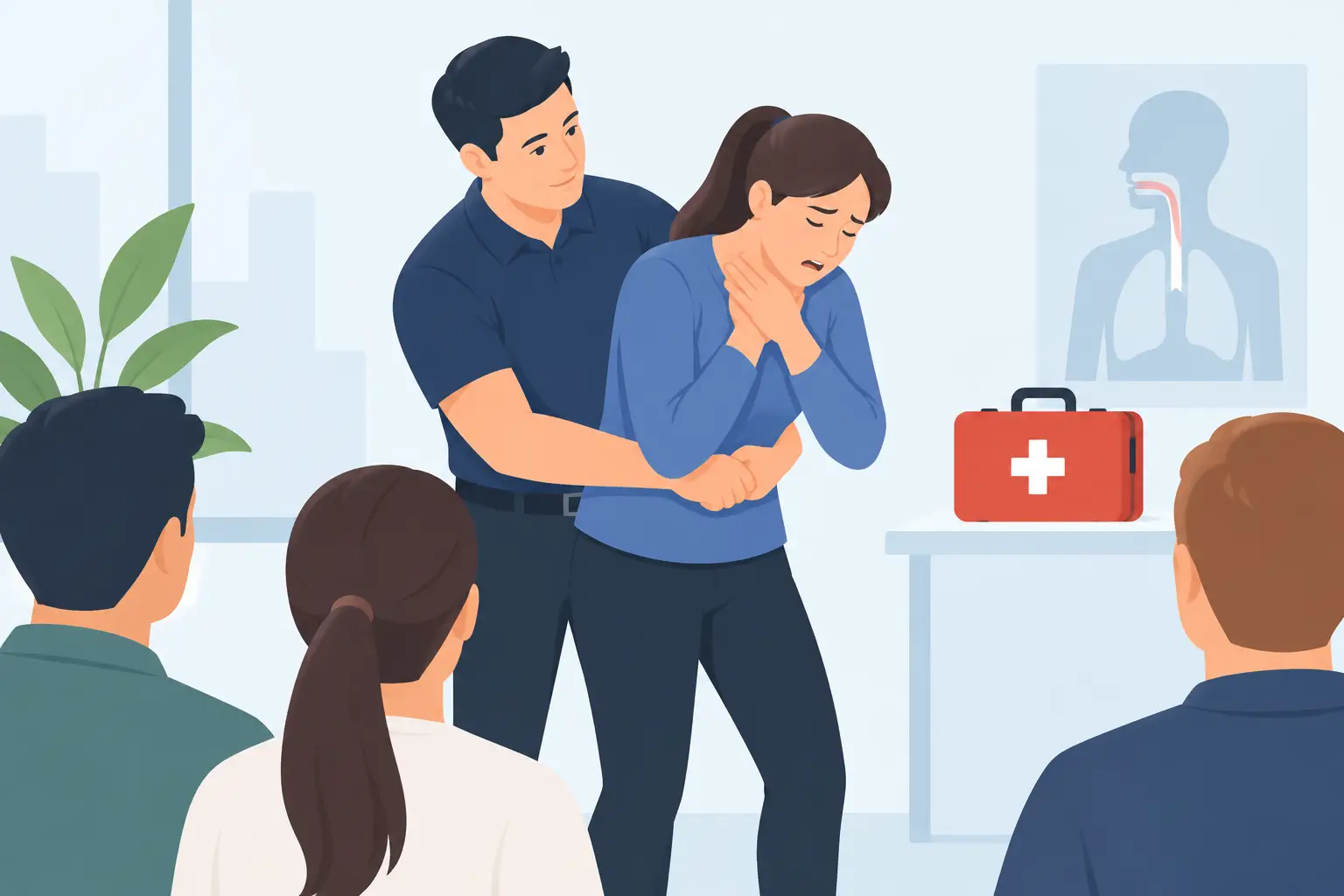
A Choking First Aid Training Course That Prepares You
A meal can become an emergency without warning. A resident coughs, then cannot speak. A toddler goes quiet near a snack table. A coworker signals distress in a break room. In those first seconds, a choking first aid training course gives responders more than a sequence to memorize. It builds the ability to recognize a severe airway obstruction, act within scope, communicate clearly, and transition to CPR when the person becomes unresponsive.
Preparedness is a responsibility, not just a card. For healthcare teams, childcare staff, school personnel, faith-community safety teams, and families, choking response training should be practical enough to hold up when adrenaline is high and time is limited.
Why Choking Emergencies Demand Hands-On Training
Choking is not always dramatic. A person with a partially blocked airway may be coughing forcefully and able to speak. That cough is doing important work. The response is different when the airway is severely obstructed and the person cannot talk, breathe, or cough effectively.
That distinction is simple on paper and difficult in a live event. Responders must assess what they see, ask direct questions when possible, call for help early, and avoid losing valuable time. Training turns those decisions into practiced actions rather than guesses.
The age of the patient also changes the response. Adult, child, and infant emergencies require different positioning, force, and technique. A caregiver who works with infants needs more than adult-focused instruction. A nursing home team needs scenarios that account for mobility limitations, dining risks, and the realities of calling additional staff to the scene.
A quality course also teaches what happens after an obstruction is relieved. The person may still need medical evaluation, particularly after a serious event, injury, or persistent symptoms. The emergency is not finished simply because an object has been expelled.
What a Choking First Aid Training Course Should Cover
The strongest choking first aid training course combines clear clinical guidance with repeated skills practice. Participants should learn how to identify the difference between mild and severe airway obstruction, activate emergency response, and use appropriate choking-relief techniques for conscious adults, children, and infants.
Instruction must also cover the critical transition point: what to do when a person becomes unresponsive. In that situation, responders need to begin CPR, look for a visible object when opening the airway, and use an AED as soon as it is available. Training should make clear that responders should not perform blind finger sweeps. Trying to retrieve an object that cannot be seen can push it farther into the airway.
For professional teams, course content should connect to the work environment. A hospital unit may need to coordinate rapid response activation. A daycare may need to assign one staff member to care for other children while another responds. A church or sports venue may need to manage crowds, direct someone to meet EMS, and locate the AED. These are operational details, but they determine whether a response stays organized.
Training should also include prevention. Safe food preparation, age-appropriate foods, supervision during meals, and awareness of small-object hazards reduce risk before a crisis begins. Prevention does not eliminate emergencies, but it is part of a complete safety plan.
Skills Practice Is Where Confidence Is Built
Watching a demonstration is not the same as being ready to respond. Choking relief requires physical practice on manikins or training equipment so participants can learn body positioning, hand placement, controlled force, and the rhythm of an organized response.
This matters especially for learners renewing a credential. Familiarity can create false confidence. A renewal course should not be treated as a quick review of information already known. It is an opportunity to correct technique, practice current protocols, and identify hesitation before it matters.
Scenario-based instruction adds another layer. Rather than asking only, “What is the next step?” an instructor can introduce realistic pressure: a child choking during lunch, an adult collapsing after a severe obstruction, or an infant who becomes unresponsive while a caregiver calls 911. Participants practice assigning tasks, speaking to the patient, using available equipment, and maintaining a calm response.
That is where EMS-informed instruction has real value. It places the skill in context. The goal is not a perfect classroom performance. The goal is competent action when the environment is noisy, the patient is frightened, and other people are looking for direction.
Choosing the Right Course for Your Role
The right course depends on who may need help and what level of responsibility you hold. Healthcare professionals and healthcare entrants generally need a BLS course that includes adult, child, and infant CPR, AED use, and choking response as part of a broader clinical skill set. A current, legitimate credential may be required by an employer, school, or licensing body.
Community learners may need a practical CPR and choking course designed for family members, coaches, teachers, and volunteers. The content should remain serious, but it should be taught in clear language without assuming clinical experience.
Organizations should consider on-site group training when ten or more people need instruction or renewal. On-site delivery can reduce travel and scheduling disruption while allowing instructors to tailor scenarios to the setting. A senior-living facility, for example, has different risks and response pathways than a manufacturing site or elementary school.
Before selecting a provider, confirm several essentials: whether the course includes adult, child, and infant skills; whether participants receive hands-on practice; whether instruction aligns with current accepted guidelines; what credential is issued; and how renewal requirements are handled. For an organization, also ask how attendance, skills verification, and documentation will be managed.
Price and convenience matter, but they are not the whole decision. The lowest-cost class can become expensive if it does not meet employer requirements or fails to provide meaningful practice. Likewise, a highly detailed course may not be the best fit for a volunteer group if it creates unnecessary barriers to participation. The right balance is credible instruction, relevant skills, and a format people can complete successfully.
Building a Workplace Response Plan Around Training
Certification alone does not create readiness. Leaders should decide what happens after someone identifies a choking emergency. Who calls 911? Who retrieves the AED? Who meets responding EMS personnel? Who documents the incident and communicates with family or administration?
These roles should be discussed before an emergency, not negotiated during one. Teams also need to know where emergency equipment is located and whether access is restricted after hours. An AED behind a locked office door is not an AED that can help when seconds matter.
Short drills can expose practical gaps without disrupting operations. A team may discover that lunch coverage leaves too few trained staff members nearby, that emergency numbers are outdated, or that employees do not know which entrance EMS should use. Those findings are valuable because they can be corrected before a real patient needs help.
BLS Updates approaches training with this operational focus. The purpose is not to move people through a class as quickly as possible. It is to prepare participants to recognize the emergency, use the skills they have practiced, and work together until higher-level care arrives.
Readiness Is the Standard
No one can predict when an airway emergency will occur. What organizations and individuals can control is whether they have trained for it. A capable response begins with recognition, continues with practiced hands-on care, and depends on a team that knows how to call for help and support one another.
Choose training that treats choking response with the seriousness it deserves. The person across the table, in the classroom, on the unit, or in the family kitchen may need someone who can act without delay.
Comments