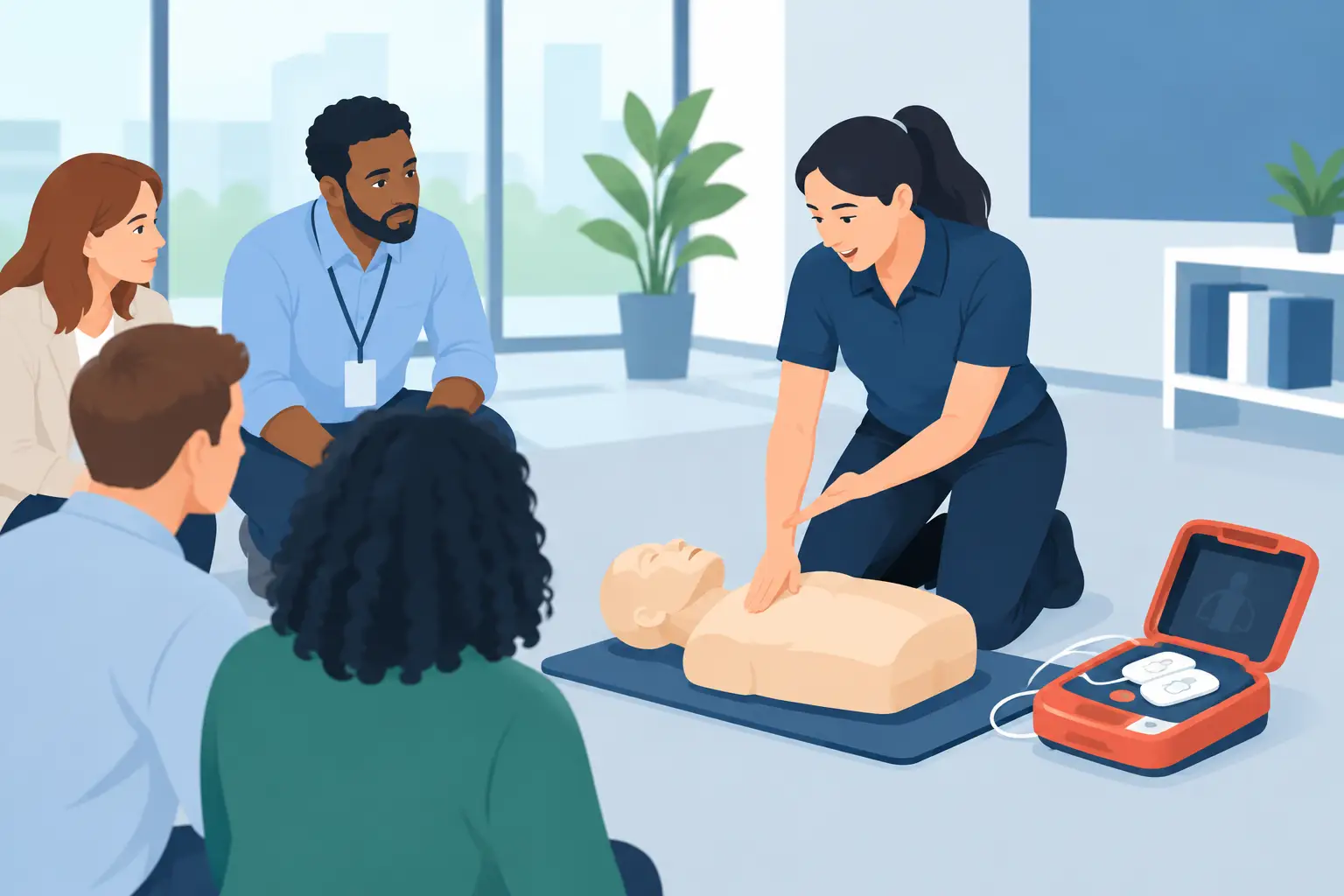
AED Training for Workplace Staff That Builds Readiness
When a coworker collapses, the first minutes belong to the people already in the building. AED training for workplace staff gives those people a practiced role: recognize a likely cardiac arrest, call 911, start high-quality CPR, retrieve the AED, and use it without delay. Preparedness is a responsibility, not just a card.
A workplace AED can be a critical resource, but the device alone does not create a response system. Staff need the confidence to act, clear direction on who does what, and enough hands-on practice that an emergency does not become a room full of hesitant bystanders. For operational leaders, the goal is not simply to check a training requirement. It is to make competent action possible when seconds matter.
Why AED Training for Workplace Staff Matters
Sudden cardiac arrest can happen in an office, warehouse, school, church, clinic, athletic facility, or break room. It does not wait for a medically trained person to arrive. Immediate CPR keeps blood moving, while early defibrillation may restore a shockable heart rhythm. The faster those actions begin, the better the chance of survival.
Modern AEDs are designed to guide rescuers with voice prompts. That design reduces barriers, but it does not eliminate them. In a real event, staff may be managing fear, a crowded scene, an unresponsive colleague, an unfamiliar device, and uncertainty about whether they are doing the right thing. Training replaces some of that uncertainty with a clear sequence.
A capable workplace response is also a team response. One person calls 911 and stays on the line. Another begins compressions. A third retrieves the AED and directs responders to the location. Additional staff can manage the scene, meet EMS at the entrance, and keep others clear. Those roles do not need to be rigidly assigned in every moment, but they should be understood before the emergency.
AED Training Is More Than Learning the Buttons
Effective instruction teaches the full response, not just how to open an AED case. Participants should practice checking for responsiveness and normal breathing, activating the emergency response system, delivering strong and consistent chest compressions, applying pads correctly, and following the AED prompts safely.
The critical safety habits are simple but must be practiced: make sure no one is touching the patient during analysis or shock delivery, remove medication patches where pads will be placed, and dry a wet chest quickly if needed. Participants should understand how to continue CPR immediately after the AED advises a shock or no shock. Time spent waiting, debating, or resetting the scene is time the patient does not have.
Training should also address the situations that create hesitation. What if the person has a pacemaker? What if the patient is pregnant? What if the AED advises no shock? What if the person is on the floor of a crowded public area? In most cases, the response remains straightforward: follow the device prompts, provide CPR, and continue until EMS takes over or the person shows clear signs of life.
Hands-on practice matters because physical skills are different from watching a video or completing a quiz. Staff need to feel proper compression depth and rate, practice applying pads on a manikin, hear AED prompts during a scenario, and coordinate with another rescuer. EMS-informed scenario training helps connect these individual skills to the pressure and movement of a real workplace emergency.
Build a Workplace Response Plan Around the AED
Training has the greatest value when it is paired with an operational plan. Start with the location of every AED. Staff should know where each device is kept without searching a directory or asking a supervisor. The path to it must remain accessible during normal operations, including after hours, during events, and when doors are secured.
The right number and placement of AEDs depends on the size and layout of the site, the number of employees and visitors, building access, and the time required to retrieve a device. A single AED may be appropriate for a small, compact workplace. A large campus, multistory facility, warehouse, school, or sports complex may require multiple devices and a more deliberate coverage plan.
Every organization should identify how 911 is called from its location. This sounds basic, but internal phone systems, locked entrances, remote sites, poor cell coverage, and unclear addresses can slow outside help. Employees should know the site address, nearest entrance, and who will meet responding EMS crews.
A practical plan answers a few operational questions before they become problems:
Who calls 911 and who retrieves the AED if an employee collapses?
Where are the AEDs, and can staff reach them at all times?
Who brings EMS from the entrance to the patient?
How will supervisors communicate the emergency without creating unnecessary confusion?
How are AED inspections, pad expiration dates, batteries, and replacement supplies tracked?
These details are not administrative extras. An AED with expired pads, a blocked cabinet, or a team that cannot direct EMS into the building is not a complete preparedness program.
Choose Training That Matches the Workplace
Not every group needs the same course design. A healthcare setting may require BLS-level training and a higher degree of clinical familiarity. A childcare program needs staff who can respond to adult, child, and infant emergencies. A corporate office may focus on adult CPR and AED response but still benefit from clear role assignments and scenario practice. Sports organizations need plans that account for large crowds, outdoor spaces, and rapid access to athletes.
The strongest option for many organizations is on-site group training. It reduces scheduling friction, allows staff to practice in the environment where they work, and gives leaders the opportunity to address site-specific procedures. If an AED cabinet is located near a loading dock, front desk, or school gymnasium, that should be part of the conversation and, when feasible, the practice scenario.
Certification is often necessary, especially for healthcare personnel and regulated roles. But a current credential is not the same as readiness. Employees may complete a course, return to demanding work, and lose confidence over time if the skills are never discussed again. Brief refreshers, occasional drills, and visible AED awareness reinforce the response chain between formal training sessions.
Keep the Program Current Without Disrupting Operations
Operational leaders often face a real trade-off: they need comprehensive training, but they cannot close a department or pull every employee off the floor at once. Planning can solve much of this problem. Schedule training in cohorts, use staggered sessions, include new-hire readiness in onboarding, and maintain a simple record of certification and renewal dates.
A designated AED coordinator, or a small safety team, can own equipment checks and training records. That person does not need to be the only rescuer. Their role is to make sure the system remains ready: devices are inspected, supplies are current, staff know the locations, and drills reveal gaps before an actual emergency does.
After any drill or real incident, review the response without blame. Did someone call 911 promptly? Was the AED easy to find? Did staff know which entrance EMS should use? Were compressions started while the AED was retrieved? A short after-action review turns experience into a stronger plan.
What Confident Staff Look Like in an Emergency
Confidence is not the absence of stress. It is the ability to take the next correct action while stress is present. A prepared employee does not need to diagnose every possible medical condition. They need to recognize an unresponsive person who is not breathing normally, activate help, begin CPR, and bring the AED into the response.
That clarity changes the culture of a workplace. Employees see that leadership has planned for more than ordinary operations. Visitors, patients, students, and families benefit from an organization that treats emergency readiness as part of its duty of care. BLS Updates approaches training with that standard: practical skills, real-world scenarios, and instruction built for action.
The most useful question for any workplace is simple: if someone collapsed here this afternoon, would our staff know exactly what to do first? Build the answer through practice, maintain it through planning, and give your people the preparation to act when a life depends on it.
Comments