On Site CPR Training for Businesses That Works
A medical emergency does not wait for a convenient calendar opening. It can happen during a shift change, in a classroom, on a warehouse floor, at a church event, or in a patient’s home. On site CPR training for businesses gives teams a chance to practice the first critical minutes where they work, with the people they will rely on when pressure is high.
A certification card has value, especially where credentials are required. But preparedness requires more than completing a course. Employees need to recognize an emergency, call for help, begin effective CPR, locate the AED, and work together without losing time. That level of readiness is built through hands-on practice and instruction that reflects the realities of the workplace.
Why On Site CPR Training for Businesses Matters
When a person becomes unresponsive or stops breathing normally, the response must be immediate. Staff may be the first people available to act before EMS arrives. Their actions can determine whether a coworker, client, student, patient, or visitor receives lifesaving care in time.
For healthcare organizations, CPR and BLS training often supports professional requirements and clinical standards. For schools, daycares, churches, sports programs, and commercial businesses, it establishes a practical safety capability that protects the people entrusted to the organization. The setting changes, but the responsibility does not.
Sending employees to separate public classes can meet a basic credentialing need. It may also create scheduling problems, inconsistent completion dates, and lost work time. On-site training brings the instruction to the team, allowing organizations to train together and coordinate the course around operational needs. For groups of 10 or more, it can be the more efficient option, particularly when staff work varied shifts or provide continuous care.
There is a trade-off. A general public class may be appropriate for one or two employees who need an individual renewal. On-site instruction becomes more valuable when a team needs a shared response plan, consistent training records, and practice that fits its specific environment.
Train for the Emergency You Are Likely to Face
The strongest group programs do not treat every workplace as identical. A nursing home team may need to consider resident mobility, clinical handoff, and rapid access to emergency equipment. Daycare personnel need confidence responding to child and infant emergencies. A manufacturing team may need to coordinate response across a large facility, while a church safety team may need to direct bystanders and communicate clearly during a crowded event.
Effective instruction should cover adult, child, and infant CPR when those populations are relevant to the organization. It should also include AED use, choking response, scene safety, and the importance of early activation of 911 or local emergency procedures. For healthcare personnel, a BLS course must also address the coordinated, high-performance team response expected in clinical and professional settings.
Scenario-based training is where knowledge becomes usable. Instead of simply identifying the correct step in a workbook, participants can practice what happens when someone must call 911, retrieve an AED, begin compressions, meet responding EMS personnel, and keep the area clear. These details are operational, not optional. Confusion about who is doing what can cost valuable seconds.
Instructors with EMS experience bring a useful perspective to these sessions. They understand what arriving responders need to know, what information helps patient care, and how easily a scene can become disorganized. That perspective keeps training focused on competent action rather than compliance alone.
What a Business Should Plan Before Scheduling
A well-run on-site course starts with a clear understanding of the organization’s needs. Leadership should identify who needs training, which credential is required, and whether the group includes new learners, experienced renewals, or both. The correct course should match job duties and governing requirements, not simply the lowest-cost option.
Schedule design matters just as much. A 24-hour care operation may need multiple sessions so coverage remains intact. A school may prefer a professional development day. A business with a smaller team may be able to train everyone in one session. The goal is to protect operations without weakening the quality of skills practice.
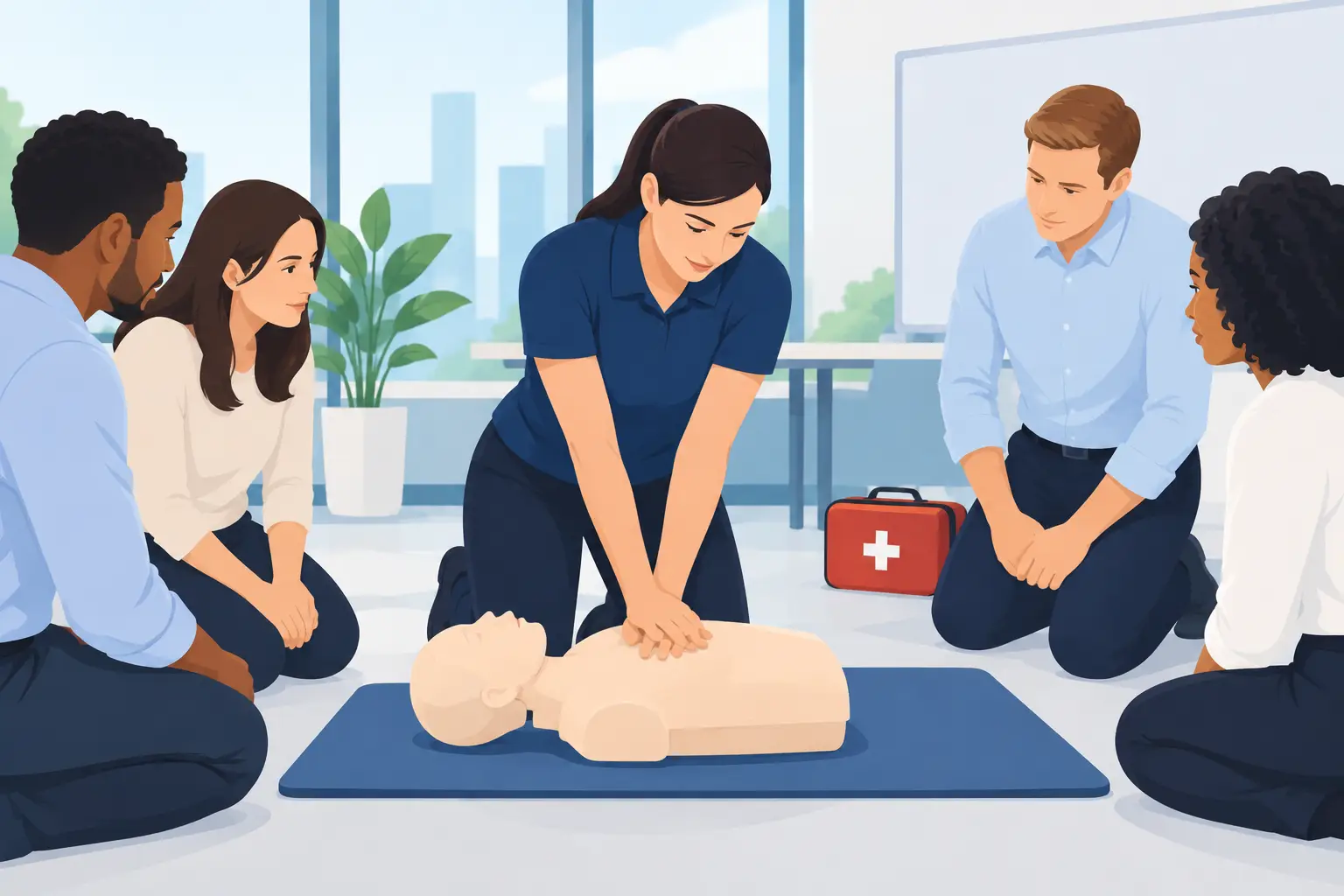
Before the class, designate a suitable training area with enough room for participants to work on the floor with manikins. Reduce unnecessary interruptions, confirm attendance, and make sure employees understand whether they are completing initial training or renewal. If your site has an AED, have it available for staff to locate and discuss during the session. Training is an opportunity to verify that equipment is accessible, maintained, and known to the people expected to use it.
It is also wise to review internal emergency procedures before training begins. Staff should know who contacts emergency services, who meets first responders, where emergency supplies are located, and how an incident is documented afterward. CPR is central, but it is one part of a complete emergency response.
Hands-On Practice Is the Standard
Watching a demonstration is not the same as performing the skill. Chest compressions require correct hand placement, depth, rate, recoil, and endurance. AED use requires calm, deliberate steps in a moment that can feel chaotic. Choking response and infant care demand techniques that cannot be learned well through passive instruction.
That is why a quality course gives each participant time to practice, receive feedback, and correct technique. Some learners arrive with years of experience. Others may never have touched a manikin. Both groups benefit from a structured environment where questions are welcome and expectations are clear.
Organizations should be cautious about treating online-only education as interchangeable with hands-on CPR instruction. Online coursework can be helpful for knowledge preparation when accepted by the relevant employer or credentialing body. But if staff are expected to perform in a real emergency, practical skills assessment remains essential. Requirements vary by role, employer, state, and licensing body, so confirm what your team must hold before selecting a format.
Make Readiness Part of Operations
Training day should not be the last time the organization considers emergency response. Credentials expire, staff turnover occurs, equipment changes location, and procedures can fade from memory. A reliable preparedness program includes renewal tracking and periodic checks of the systems that support a response.
After a group session, leaders should confirm that AEDs are visible and serviceable, emergency numbers are current, first-aid supplies are stocked, and new employees understand the response plan. In higher-risk settings, brief drills can reveal practical gaps: a locked supply room, unclear access to an AED, or uncertainty about who takes charge before EMS arrives.
This work should be handled with purpose, not alarm. Most employees will never need to perform CPR at work. The point is to ensure they can act decisively if the moment comes. Preparedness gives people a defined role when fear and uncertainty might otherwise take over.
BLS Updates provides on-site group training built around hands-on skills practice, EMS-informed instruction, and scheduling that respects the demands of active organizations. Whether your team needs initial certification, renewal, or a broader workplace readiness plan, the training should fit the people, setting, and responsibilities involved.
A workplace cannot predict every emergency. It can decide whether its people will be ready to respond with skill, composure, and care when someone’s life depends on the next action.
Comments