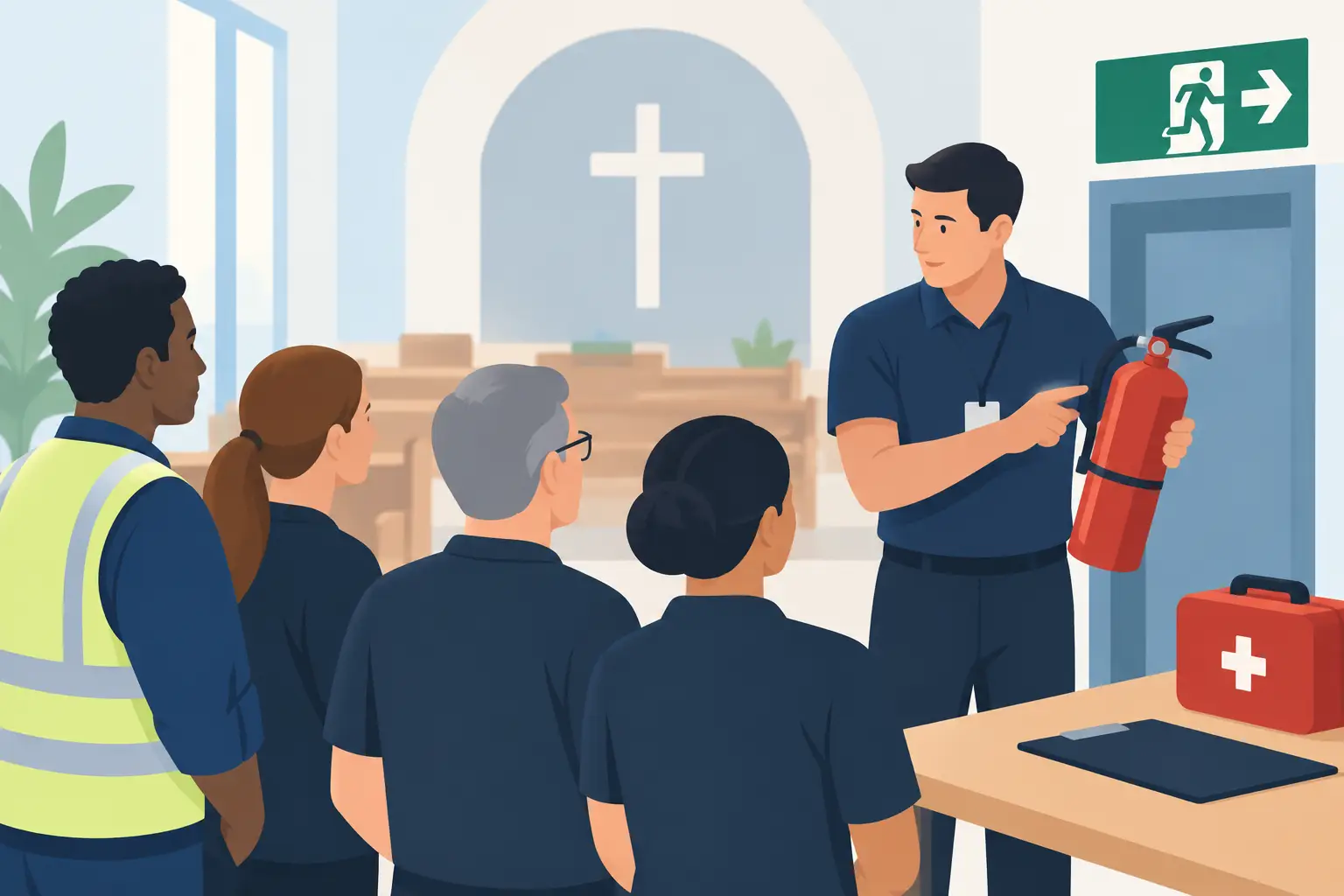
Church Safety Team Emergency Training That Works
A medical crisis rarely announces itself at a convenient time. It may happen during worship, in a crowded hallway between services, at a children’s check-in area, or in the parking lot as families leave. Effective church safety team emergency training prepares people to act with calm purpose in those first critical minutes - before EMS arrives and before uncertainty turns into confusion.
A church safety team is not expected to replace police, fire, or emergency medical services. Its responsibility is more immediate and practical: recognize danger, protect people, communicate accurately, provide care within training, and guide responders to the right place. That requires more than a binder, a radio, or a CPR card. It requires practiced decisions under pressure.
What Church Safety Team Emergency Training Must Cover
The strongest programs are built around the emergencies a church is most likely to face, not around dramatic scenarios alone. Cardiac arrest, choking, falls, diabetic emergencies, seizures, severe bleeding, missing children, disruptive behavior, weather events, fires, and evacuation problems all demand different actions. A team that can respond to only one type of event is not fully prepared.
Medical response should be central to the training plan. Churches often include infants, children, older adults, visitors, and people with known or unknown medical conditions. Teams need hands-on competence in adult, child, and infant CPR, AED use, choking response, and basic bleeding control. They should know where equipment is stored, who can retrieve it, and how to direct someone to call 911 without creating a crowd of bystanders.
Training also needs clear boundaries. Volunteers should never be encouraged to diagnose illness, administer medication outside approved policies, or take physical action beyond their training and the immediate need to protect someone. The goal is competent first response, not improvisation. A disciplined team knows when to intervene, when to step back, and when to transfer command to arriving professionals.
The first five minutes need a plan
When an emergency occurs, a team should not have to decide from scratch who does what. Assigning operational roles in advance prevents duplication and missed steps. In a small church, one person may hold more than one role. In a large campus, the roles can be distributed across services and buildings.
A functional response plan identifies who will:
Assess the scene for danger and make initial contact with the affected person
Call 911 and relay the exact address, building entrance, and nature of the emergency
Retrieve the AED, trauma kit, first aid supplies, or evacuation equipment
Meet emergency responders and escort them quickly to the scene
Manage nearby people, protect privacy, and communicate with church leadership
These assignments must work when the usual leader is absent. Rotate roles during practice and train backups. A Sunday-morning team made up entirely of one key volunteer’s knowledge is not a dependable system.
Training for Medical Emergencies, Not Just Certification
A certification course provides essential skills, but retention depends on repetition. Someone may understand CPR in a classroom and still hesitate when a person collapses in a sanctuary. Scenario practice closes that gap. It lets volunteers hear the call for help, locate the AED, work around pews or crowded classrooms, communicate with one another, and begin care while others manage the scene.
Realistic training should account for the church’s layout. Is the AED visible and accessible during every service? Can a team member reach it quickly from the nursery, fellowship hall, or parking lot? Does a locked exterior door delay EMS access? Are there radios, and does everyone know the correct channel and plain-language call signs? These details determine whether a plan functions in real conditions.
CPR and AED instruction should include adult, child, and infant response when the church serves families. Childcare volunteers, youth leaders, greeters, ushers, security personnel, and pastoral staff may all be present when an emergency begins. They do not all need identical responsibilities, but they need a shared understanding of how to activate the response system.
BLS Updates approaches group instruction with practical, EMS-informed scenarios because competence matters when the environment is noisy, crowded, and emotionally charged. For a church team, that means practicing the actions that create time for a patient: early recognition, rapid 911 activation, quality CPR, AED use, and a clear handoff to responders.
Security Incidents Require Judgment and Restraint
Church safety is not only medical. Teams may encounter an agitated visitor, a domestic conflict, a person experiencing a behavioral health crisis, a suspected weapon, or a credible threat outside the building. These situations require planning, but they should not turn volunteers into amateur law enforcement.
De-escalation is often the first and best skill. Training should teach volunteers to use calm communication, maintain distance, avoid trapping a person, request additional help early, and move uninvolved people away from the area. When there is an immediate threat of violence, the priority shifts to getting people to safety, contacting 911, and following the church’s established emergency procedures.
Policies should define when the team contacts law enforcement, who communicates with officers, and how staff and volunteers report concerns before they become an emergency. A vague instruction to “keep an eye on things” is not a policy. Clear reporting channels and documented expectations give people permission to speak up without overreacting.
There is a trade-off in every security plan. A highly visible presence can deter some risks and reassure congregants, but an overly aggressive posture can make a church feel unwelcoming or escalate a misunderstanding. The right balance depends on the congregation, facility, service times, neighborhood, and known risks. Preparation should be proportionate, thoughtful, and reviewed regularly.
Drills Reveal the Gaps a Meeting Will Miss
Written plans are necessary. Drills reveal whether those plans can be carried out. A tabletop exercise is useful for leadership: walk through a scenario, discuss decisions, and identify policy gaps. A live drill tests movement, equipment access, communication, and role clarity.
Start with controlled scenarios. Practice a cardiac arrest in the sanctuary during a mock service. Run a missing-child drill at check-in. Test a weather shelter plan during a weekday program when fewer leaders are present. After each exercise, ask direct questions: How long did it take to call 911? Was the AED easy to locate? Did anyone give conflicting instructions? Could responders enter without delay?
Do not treat an after-action review as blame. It is where readiness improves. If a radio battery failed, replace the process that allowed it to go unnoticed. If team members were unsure who could speak to a family, clarify the role. If a locked door delayed access, change the access plan. Small corrections made after a drill can prevent major failures later.
Build a Response System the Whole Church Can Support
The safety team cannot operate as an isolated group. Children’s ministry leaders need to know evacuation and reunification procedures. Greeters need to know whom to notify when they see a concern. Facility staff need to keep emergency equipment accessible and inspected. Pastoral leaders need a communication plan that protects privacy while offering appropriate care to the congregation.
Equipment matters, but it is not the foundation. An AED that no one can find, an emergency bag with expired supplies, or a radio system used only by two volunteers creates false confidence. Assign regular inspection responsibilities and document them. Check AED status indicators, batteries, pads, first aid supplies, exterior lighting, emergency exits, and posted address information on a schedule.
Review the plan after changes in staff, facilities, service schedules, or attendance. A church that adds a second campus, expands children’s programming, or changes its main entrance has changed its emergency response environment. Training must keep pace.
Preparedness is a responsibility, not just a card. When a church safety team practices its roles, maintains lifesaving equipment, and trains for the people it serves, volunteers gain something more valuable than a checklist: the confidence to provide order, care, and protection when their community needs them most.
Comments