BLS Certification Requirements: What You Need
A BLS card can be checked in seconds. The competence behind it may be needed in the first seconds of a cardiac arrest, respiratory emergency, or choking event. That is why BLS certification requirements should be treated as a readiness standard, not a paperwork task. For healthcare professionals and the organizations that employ them, the right course must satisfy credentialing rules while preparing people to act with speed, precision, and control.
What BLS Certification Requirements Usually Include
Basic Life Support certification is designed for healthcare personnel and professional responders who may need to manage life-threatening emergencies as part of their work. It goes beyond a basic community CPR course by emphasizing high-quality team response, clinical decision-making, and skills appropriate for adults, children, and infants.
Most BLS certification requirements include completion of an approved course, active participation in hands-on practice, and successful completion of both knowledge and skills evaluations. The exact standard depends on the employer, licensing body, school, hospital, or agency requesting the credential. A nurse entering a hospital system, for example, may face different documentation rules than a home-health employee, EMT student, or church safety-team volunteer.
A legitimate BLS course typically covers recognition of cardiac arrest and respiratory distress; high-quality CPR for adults, children, and infants; proper use of an automated external defibrillator, or AED; relief of choking; rescue breathing; and team-based resuscitation. Participants practice the sequence of assessment, activation of emergency response, compressions, ventilation, defibrillation, and handoff.
For professional settings, the team component matters. Effective BLS is not simply knowing where to place your hands. It requires clear role assignment, closed-loop communication, minimal interruptions in compressions, and the confidence to correct a problem before it costs precious time.
Confirm What Your Employer Will Accept
Before booking, verify the credential requirement with your employer, program administrator, or licensing office. This step prevents one of the most common problems in workforce training: completing a course that does not meet the organization’s accepted standard.
Ask which issuing organization is required or accepted, whether an instructor-led skills session is mandatory, and whether a blended course format is permitted. Some employers accept a course that combines online learning with an in-person skills evaluation. Others require fully instructor-led training. Many clinical workplaces will not accept an online-only CPR certificate because it does not demonstrate hands-on performance.
You should also confirm whether you need BLS for Healthcare Providers or a community CPR course. Community CPR training can be an excellent fit for parents, coaches, teachers, church teams, and general workplace responders. Healthcare roles commonly require a BLS credential that includes professional-level skills and team dynamics.
Organizations should document their requirements clearly for new hires and existing staff. A vague instruction such as “get CPR certified” creates avoidable confusion, missed deadlines, and rejected cards. Specify the accepted credential, renewal interval, training format, and the date by which proof of completion must be submitted.
Initial BLS Certification: What New Learners Need
There is generally no universal experience requirement to enroll in an initial BLS course. New healthcare entrants, medical assistants, nursing students, home-health workers, and public-safety personnel can begin with foundational instruction. What matters is the ability to participate fully in the practical skills session and demonstrate each required skill correctly.
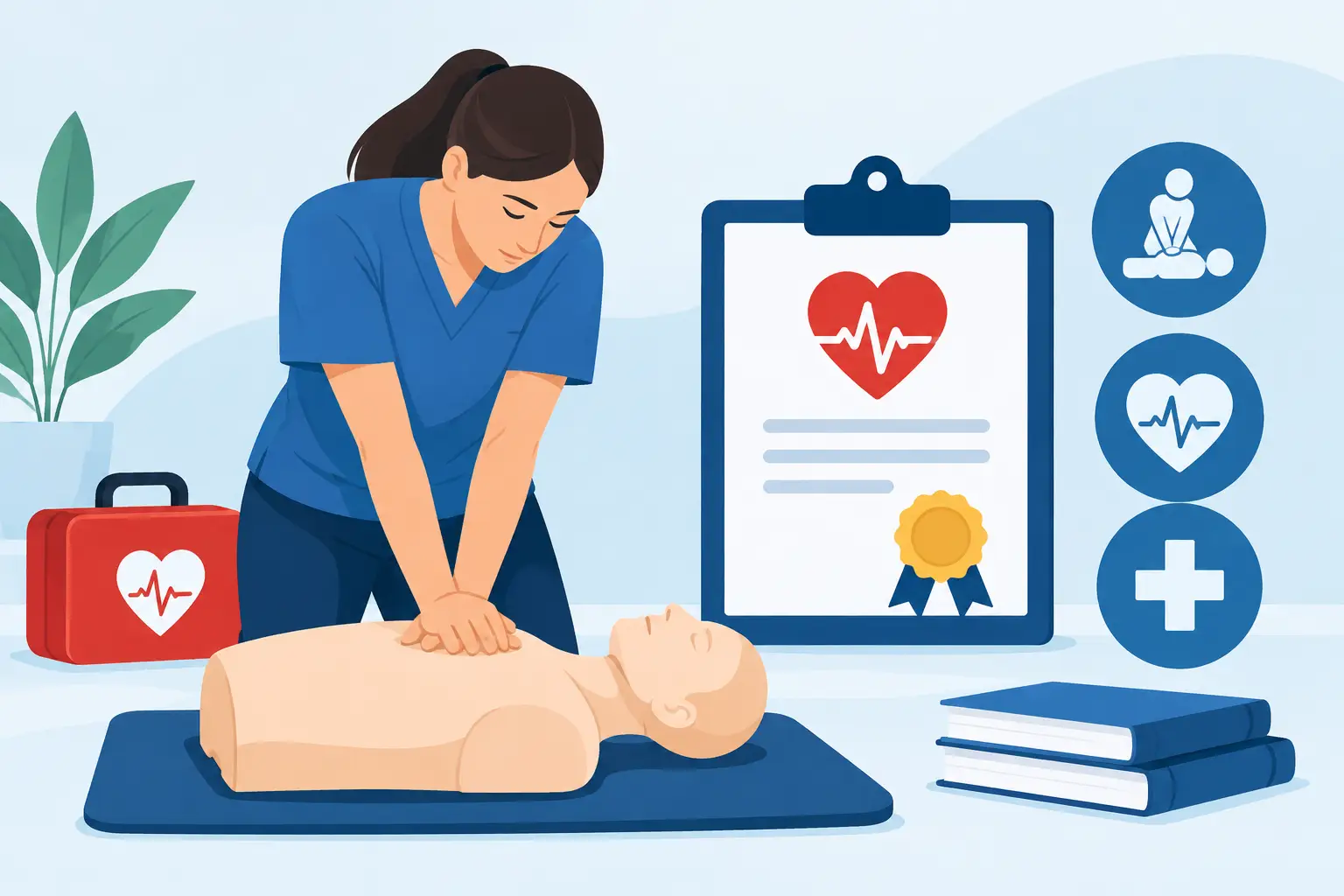
Initial certification courses usually include instructor guidance, demonstration, practice time, and formal testing. Learners should expect to work on CPR manikins and AED trainers rather than only watch videos or complete written material. Repetition is part of the standard. Correct compression depth, rate, recoil, ventilation technique, and AED workflow need to become usable under pressure.
Wear comfortable clothing that allows you to kneel, bend, and perform chest compressions. Arrive on time and plan to stay through the assessment. Depending on the course structure, participants may complete online material before attending the hands-on session. If pre-course work is assigned, finish it before class. An incomplete module can delay certification even when skills are strong.
Passing is not about memorizing a script. Instructors evaluate whether you can recognize the emergency, begin appropriate care, use equipment safely, and perform within the expected sequence. If a learner struggles, quality instruction includes coaching and another opportunity to practice. The goal is competent performance, not rushed completion.
Renewal Requirements and Expiration Dates
Most BLS credentials are valid for two years, but the expiration date on the card and the policy of the credentialing organization should guide your renewal plan. Employers may require renewal before the card expires, especially when a lapse would remove an employee from patient care, clinical placement, or assigned response duties.
Do not wait until the final week. Course availability, work schedules, travel, and documentation delays can turn a simple renewal into a credentialing issue. A practical rule is to schedule renewal several weeks before expiration and keep a digital and printed copy of the updated card where your employer can access it.
Whether an expired card qualifies for a renewal course depends on the issuing organization and the employer. Some programs allow a short grace period; others require an initial course once certification has lapsed. If you are changing employers, confirm the new organization’s policy rather than assuming your prior workplace standard will transfer.
Renewal training should not feel like a shortcut around skill practice. Experienced clinicians may know the material well, but CPR techniques, guidelines, equipment workflows, and team roles still require review. Renewal is the opportunity to correct habits, refresh timing, and practice coordinated response before an actual emergency tests the team.
Skills That Must Be Demonstrated
A BLS credential is meaningful because it requires performance, not just attendance. While the exact assessment process varies by course provider, participants are commonly expected to demonstrate several core abilities:
Adult, child, and infant CPR with appropriate technique
AED use and safe clearing of the patient during analysis and shock delivery
Rescue breathing and bag-mask ventilation concepts where included in the course
Choking relief for responsive and unresponsive adults, children, and infants
Two-rescuer CPR and effective team communication
For healthcare personnel, high-quality compressions remain central. Compression rate, depth, full chest recoil, correct hand placement, and reduced pauses all affect the quality of circulation during cardiac arrest. An instructor should be able to observe, coach, and verify these skills directly.
This is why hands-on instruction is worth protecting in a busy schedule. A card earned without practical feedback may satisfy no one when a responder must manage a real patient, an AED, a crowded room, and a team waiting for direction.
Requirements for Employers and Team Leaders
For an organization, BLS readiness is larger than collecting certificates. Leaders need a reliable process for identifying which roles require training, tracking expiration dates, onboarding new staff, and maintaining coverage when employees are in class.
On-site group training can reduce disruption for hospitals, nursing homes, schools, businesses, churches, and sports organizations with teams of 10 or more. It also gives instructors an opportunity to frame scenarios around the setting. A daycare team may need extra focus on infant and child response. A church safety team may need to consider crowd management, communication, and AED access. A clinical team may need practice with role clarity during a code response.
Choose training that matches the realities of your environment. The lowest-cost or fastest option is not always the right option if it leaves staff without accepted credentials or without enough time on the equipment. BLS Updates emphasizes EMS-informed, scenario-based practice because preparedness must hold up beyond the classroom.
Keep a current training roster with employee names, credential type, issue date, expiration date, and documentation status. Assign one person to monitor upcoming expirations, but do not make readiness dependent on a single spreadsheet owner. Managers should have visibility into gaps, particularly in roles that require continuous coverage.
A Better Standard Than “Certified”
The right BLS course meets the required credential standard, but it should also leave participants ready to recognize a crisis and take the next correct action. When selecting initial training or renewal, confirm acceptance first, then look closely at the skills practice, instructor experience, and opportunity to work through realistic scenarios.
Prepared people do not wait for someone else to take control. They assess, call for help, begin care, use the AED, communicate clearly, and continue until a higher level of care arrives. That is the standard worth carrying into every shift, every facility, and every community.
Comments