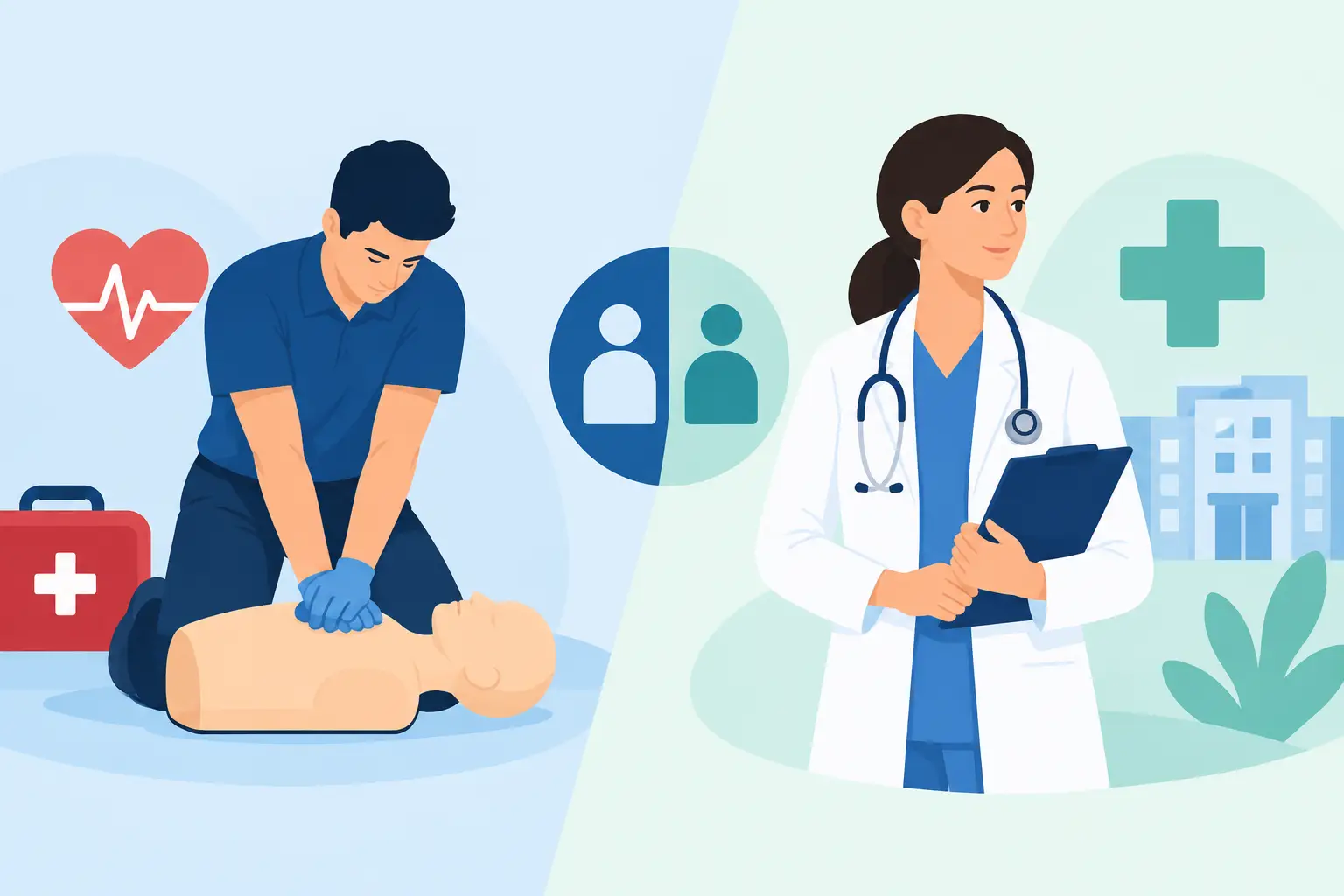
BLS Provider Versus Healthcare Provider Explained
A job title does not automatically tell you which CPR credential you need. The question of BLS provider versus healthcare provider usually comes up when someone is renewing a card, starting a clinical role, or trying to meet an employer requirement without taking the wrong course.
The short answer is this: a healthcare provider is a professional role, while BLS Provider generally refers to a level of emergency-response training or a credential. They overlap often, but they are not interchangeable terms. Knowing the difference protects your compliance status and, more importantly, prepares you to respond when a patient, coworker, or family member suddenly collapses.
BLS Provider Versus Healthcare Provider: The Core Difference
A healthcare provider is someone who delivers, supports, or assists with patient care. This can include nurses, physicians, EMTs, paramedics, medical assistants, dental professionals, home-health staff, therapists, technicians, and students entering clinical programs. The term describes what you do or the setting in which you work. It does not, by itself, identify your CPR training level.
A BLS Provider is a person trained in Basic Life Support at the professional-rescuer level. In many workplaces, the phrase also appears on a course name or certification card. BLS training is designed for people who may need to recognize cardiac arrest quickly, begin high-quality CPR, use an AED, manage choking, and work as part of a coordinated response team.
Many healthcare professionals need BLS certification because their role places them near patients and medical emergencies. But not every person in healthcare has the same requirement. An employee in a nonclinical administrative role, for example, may be required to complete community CPR or may have no mandated credential at all. The deciding factor is the employer's policy, licensing standard, school program, clinical site, or job description.
Why the Names Create Confusion
Course names have changed over time, and different training organizations use slightly different language. You may see terms such as BLS Provider, BLS for Healthcare Providers, healthcare professional CPR, or professional rescuer CPR. These labels can describe similar provider-level training, but acceptance is never something to assume.
Some employers specify the exact issuing organization they accept. Others require a hands-on skills session, an instructor-led class, or a card that is valid for a particular period. A course that meets the needs of a community volunteer may not meet a hospital credentialing department's requirements, even if both courses teach CPR.
That is why the question should not be, “Which class sounds close enough?” It should be, “What credential does my employer or program require, and does this course meet that requirement?” Confirm that before registering, especially if you are starting orientation, entering nursing school, renewing a license, or preparing for a clinical placement.
BLS Is Built for Professional Response
Community CPR is valuable training. It teaches people how to recognize an emergency, call for help, provide CPR, use an AED, and respond to choking. For parents, teachers, coaches, church safety teams, and workplace employees, those skills can make a critical difference before EMS arrives.
BLS provider-level training goes further because clinical and public-safety personnel may respond in teams, with equipment, in environments where seconds matter. Training commonly includes adult, child, and infant response; high-performance CPR principles; AED use; relief of foreign-body airway obstruction; and team-based skills such as coordinating compressions, ventilation, and scene roles.
The difference is not about making one group more valuable than another. A trained bystander can save a life. The difference is the expected response environment. A nurse responding on a hospital unit, an EMT responding in the field, and a daycare worker responding to a child may all need to act decisively, but their workplace policies, equipment, and credential requirements can differ.
Who Usually Needs BLS Provider Training?
BLS is commonly required for direct-care and patient-facing professionals. Nurses, nursing assistants, physicians, EMTs, paramedics, respiratory therapists, dental teams, medical assistants, behavioral health staff, home-health workers, and allied-health students are frequent examples.
It may also be required for staff whose work brings them into clinical, athletic, educational, or high-risk public settings. Athletic trainers, school health personnel, lifeguards, security teams, childcare professionals, and some workplace safety teams may need BLS depending on their organization’s policy.
Still, job title alone does not settle the issue. A medical assistant in one practice may need a specific BLS credential for all clinical staff, while another organization may define different standards based on duties. A home-health agency may require BLS for field personnel but not for scheduling staff. A church safety team may choose provider-level training because its response plan includes an AED and designated responders, even though its members are not healthcare professionals.
When requirements are unclear, ask the person responsible for compliance or onboarding for three details: the accepted credential, the accepted training organization, and whether hands-on skills verification is required. Those answers prevent the frustration of completing a class that cannot be accepted.
What a Strong BLS Course Should Prepare You to Do
A legitimate credential matters, but a card is not the finish line. In a real cardiac arrest, there is no pause to review course material or search for a protocol. The value of training is the ability to recognize the emergency, take command of your role, and begin effective action without delay.
A quality BLS course should give participants repeated hands-on practice with adult, child, and infant skills. Learners should perform compressions, use an AED trainer, practice ventilation when applicable, and work through scenarios that require communication with another responder. Feedback matters because CPR quality is physical and measurable. Depth, rate, recoil, positioning, interruptions, and coordinated teamwork affect whether resuscitation efforts are effective.
Scenario-based instruction also exposes practical challenges that a video alone cannot solve. Who calls 911? Who retrieves the AED? When do you switch compressors? How do you manage a cramped room, a panicked bystander, or a child whose condition changes quickly? Confidence comes from practicing those decisions under instruction, not from checking a completion box.
BLS Updates approaches training with that operational standard. Certification is necessary, but preparedness is the responsibility. EMS-informed instruction helps participants connect the required skills to the moments when those skills are needed most.
Initial BLS Certification and Renewal Are Not Identical
If you are new to healthcare, returning after an expired credential, or entering a clinical program, an initial BLS class is usually the right starting point. It allows time to build the skill sequence, become comfortable with equipment, and receive direct correction from an instructor.
Renewal is intended for participants who hold a current or recently valid credential and need to maintain their requirement. The right renewal process depends on the policy of the employer or program. Some organizations have strict expiration rules. Others allow a short grace period, while some treat an expired card as a new certification requirement.
Do not wait until the week your card expires to verify the policy. Credentialing delays can affect scheduled shifts, clinical access, onboarding, and contract work. For organizations, last-minute renewals can leave units short-staffed or force employees to seek inconsistent training on their own time.
Choosing the Right Course Without Guesswork
Start with the written requirement from your employer, school, licensing board, or clinical site. Match the course level and issuing organization to that requirement. Then make sure the course includes the format you need, particularly hands-on skills instruction if your organization requires it.
For individual learners, convenience matters, but it should not replace training quality. Choose a course that provides clear instruction, practical feedback, and a legitimate certification process. For healthcare entrants, it is wise to confirm acceptance before paying for a course rather than relying on a program’s general description.
For managers and safety leaders, standardization is often the better operational choice. On-site group training can help teams train under one schedule, receive consistent instruction, and practice response roles relevant to their own facility. A nursing home, dental office, school, church, or business with an AED program should train not only for individual completion, but for how the team will function during an emergency.
The Credential Is Only Useful If You Can Use It
The BLS provider versus healthcare provider distinction becomes simple once you separate profession from preparation. Your job may place you in healthcare, but your required emergency credential is determined by your responsibilities and your organization’s standards.
Before your next shift, clinical rotation, or renewal deadline, verify the requirement and choose training that builds more than compliance. When someone stops breathing or collapses without warning, prepared people do not need perfect conditions. They need the competence to begin.
Comments