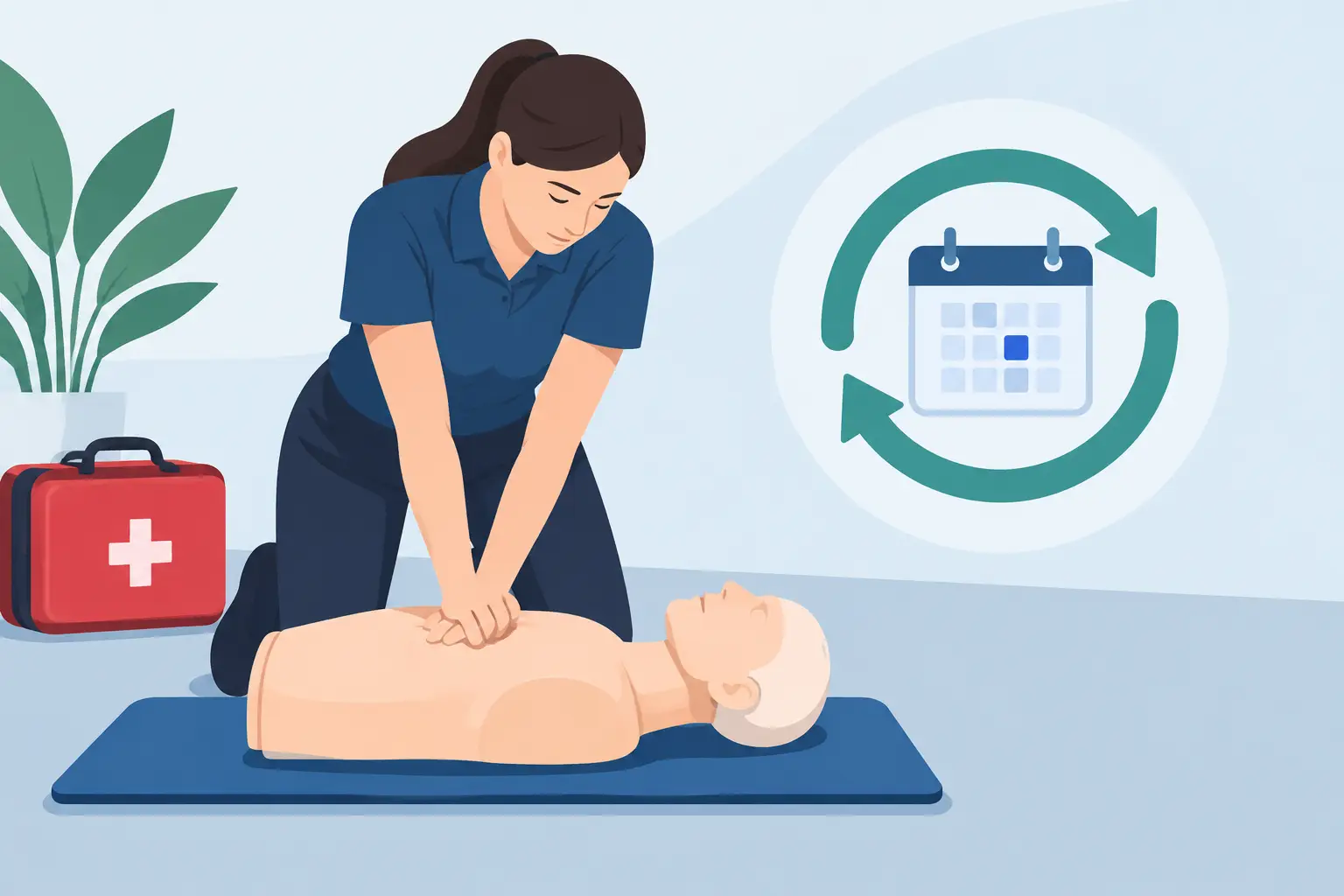
CPR Training Frequency: When Skills Need Renewal
A CPR card may remain valid for two years, but CPR training frequency should never be treated as a two-year question alone. In a cardiac arrest, responders must recognize the emergency, call for help, start effective compressions, use an AED, and work as a team without waiting for instructions. That level of performance depends on more than remembering a course.
For healthcare professionals, public-safety personnel, and organizations responsible for staff readiness, the right interval is the one that protects both credential compliance and real-world competence. Those intervals are related, but they are not the same.
The standard renewal interval for CPR and BLS
Many employer-recognized BLS credentials are issued for two years. Healthcare employers, hospitals, nursing facilities, EMS agencies, and other regulated settings commonly require renewal before that expiration date. A lapsed credential can affect scheduling, clinical eligibility, onboarding, and an organization’s compliance status.
Two years is a certification cycle, not a guarantee that every skill will remain sharp for two years. The exact requirement depends on the credentialing organization, employer policy, state regulations, and job role. A nurse working on a high-acuity unit may have different internal expectations than a school staff member, a home-health worker, or a church safety-team volunteer.
The operational rule is straightforward: confirm the credential your employer accepts, know its expiration date, and schedule renewal early enough to avoid a lapse. Waiting until the final week creates unnecessary risk. Classes fill, schedules change, and a missed renewal can become a work interruption.
Why CPR skills fade before certification expires
CPR is physical, time-sensitive work. It requires correct hand placement, appropriate compression depth and rate, full chest recoil, minimal interruptions, rescue-breathing technique when required, and confident AED operation. These are not skills most people reinforce during a normal workday.
Research and field experience consistently point to the same operational reality: psychomotor skills and recall decline when they are not practiced. A responder may remember that CPR matters while still hesitating over the sequence, losing compression quality, or struggling to coordinate with another responder.
That gap matters. Cardiac arrest does not allow time to search for a protocol, debate roles, or relearn where AED pads belong. The first minutes shape the rest of the response.
This does not mean every employee needs a full certification class every few months. It means organizations should distinguish between renewal training and skills reinforcement. A full renewal confirms current training and credential status. Short, hands-on practice sessions keep the response from becoming theoretical.
Experience changes the practice need
A paramedic or emergency department nurse may encounter resuscitation far more often than an office employee or daycare administrator. Regular exposure can reinforce recognition, communication, and equipment familiarity. Even so, infrequent steps can fade, especially when protocols, equipment, or team assignments change.
For professionals and teams who rarely respond to emergencies, more frequent practice is often more valuable. A team that has not touched its AED, practiced a call-for-help sequence, or assigned response roles in a year may be certified but not operationally ready.
A practical CPR training frequency for different roles
A two-year renewal cycle is often the baseline for required BLS or CPR credentials. The stronger readiness plan adds brief, scheduled reinforcement between renewal classes.
For healthcare teams, quarterly or semiannual practice can be appropriate, particularly in environments with low arrest volume or frequent staffing changes. These sessions do not need to disrupt an entire shift. A focused scenario can cover recognition, high-quality compressions, AED use, role assignment, and handoff communication in a short period.
For schools, daycares, churches, fitness facilities, and workplaces, an annual CPR and AED skills check is a practical standard. It gives staff a chance to handle the equipment, review the emergency plan, and identify gaps before an event occurs. Organizations with higher-risk populations, large campuses, athletic programs, or remote locations may benefit from more frequent drills.
Community learners should renew according to the requirements of their employer or volunteer role, but they should also seek practice when confidence drops. Parents, caregivers, coaches, and family members do not need to wait for a card to expire if they no longer feel prepared to act.
What a meaningful skills refresher should include
A refresher is useful only when participants perform the work. Watching a video or reviewing slides may reinforce knowledge, but it does not show whether someone can deliver effective compressions under pressure.
A meaningful session should put learners on the manikin and require them to work through a realistic response. Participants should practice recognizing unresponsiveness and abnormal breathing, activating emergency response, delivering high-quality CPR, using an AED, and transitioning between responders. Teams should also practice communication: who calls 911, who retrieves the AED, who begins compressions, and who directs arriving responders.
Adult, child, and infant emergencies should be addressed based on the population a team serves. A pediatric office, daycare, school, or family-centered church program cannot treat child and infant response as an optional add-on. The equipment, compression approach, and urgency of early recognition require specific practice.
Equipment checks belong in the same plan
Training frequency means little if the AED cannot be located, its pads are expired, or staff do not know who brings it to the scene. Each practice session is an opportunity to check response equipment and clarify procedures.
Organizations should confirm that AEDs are accessible, visible, and maintained; first-aid supplies are stocked; emergency numbers and facility addresses are easy to provide; and staff understand who meets EMS at the entrance. These details are easy to overlook until the moment they become critical.
Signs your team needs training sooner
Expiration dates are not the only trigger for training. A change in risk, staffing, equipment, or operations can justify earlier instruction.
Consider moving training forward when your organization opens a new location, purchases an AED, changes its emergency-action plan, adds a high-risk service, experiences significant turnover, or identifies confusion during a drill. The same is true after a real emergency. A structured debrief may reveal that the team needs clearer roles, more hands-on practice, or a better plan for contacting EMS.
New hires also need attention. A strong response plan fails if only a few long-tenured employees know it. Build CPR and AED orientation into onboarding where the role and setting warrant it, then reinforce it during team training.
How leaders can make CPR readiness manageable
The common obstacle is not a lack of concern. It is scheduling. Healthcare facilities, schools, offices, and service organizations cannot simply close operations for training. The answer is to plan ahead rather than compress every requirement into the final days before expiration.
Start with a credential roster that includes each employee’s course type, issue date, expiration date, role, and required training level. Review it monthly. This gives leaders time to group renewals, address upcoming lapses, and schedule sessions around operational needs.
For teams of 10 or more, on-site training can reduce travel, protect staffing coverage, and let instructors address the actual environment where a response would occur. BLS Updates builds hands-on sessions around adult, child, and infant emergencies so teams can practice the decisions and actions their setting may require.
The goal is not to create training for training’s sake. It is to make correct action more likely when a patient, coworker, student, or family member suddenly collapses.
Certification proves completion. Practice builds response.
CPR training frequency should be set with both obligations in mind: renew credentials on time and rehearse critical actions often enough to preserve confidence. For most people, the certificate renewal date is the minimum benchmark. For responsible teams, readiness is measured by whether people can act immediately, communicate clearly, and use the equipment available.
The next time you review a CPR expiration date, ask a better question: if an emergency happened this afternoon, would the team know exactly what to do? If the answer is anything less than yes, the right time to practice is before the card expires.
Comments