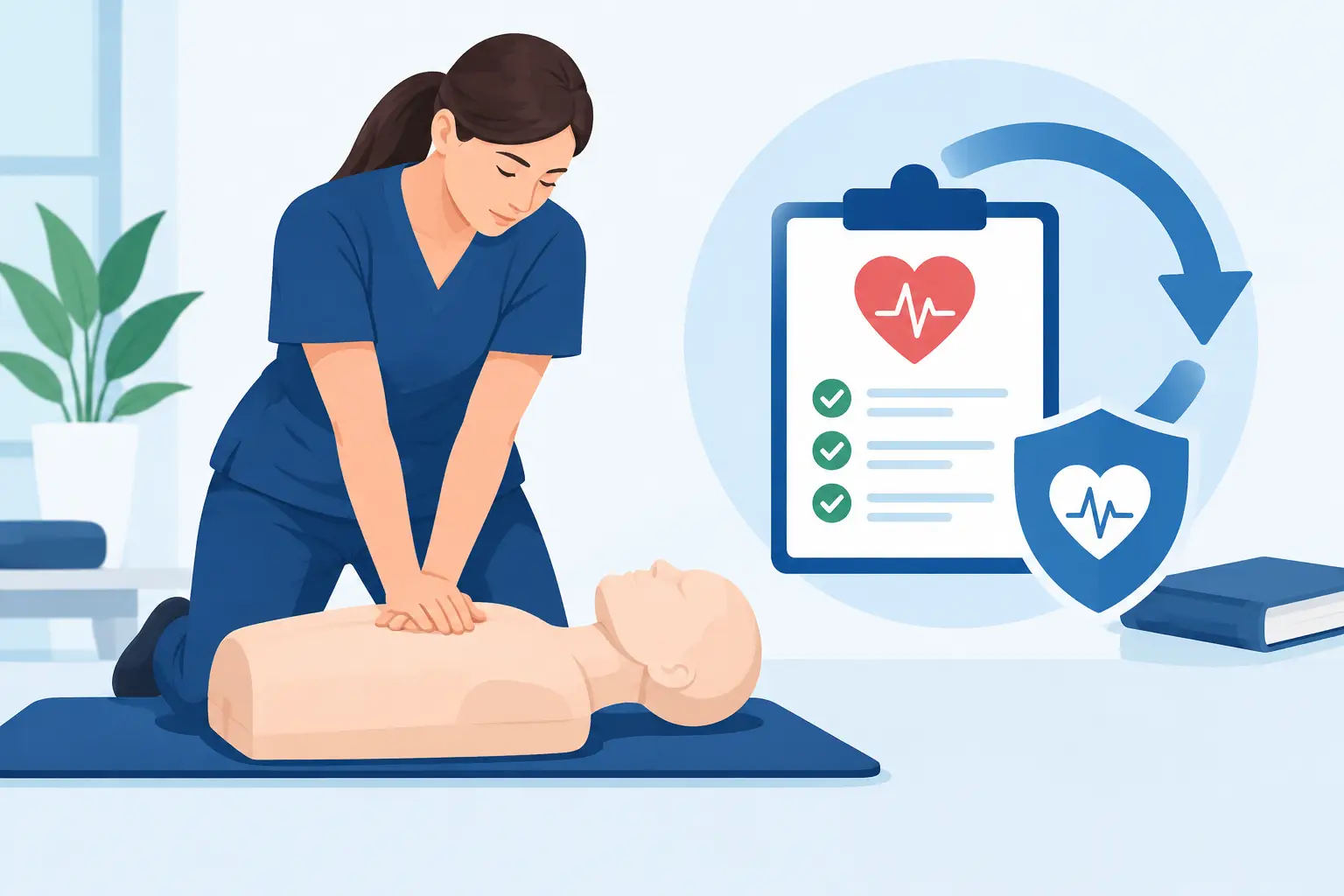
BLS Renewal Guide for Confident Recertification
A BLS card may be required for your role, but renewal is about more than keeping a credential current. This BLS renewal guide is built for professionals who may be called to act when a patient, coworker, resident, child, or visitor collapses without warning. The goal is not simply to pass a class. It is to return to duty able to recognize an emergency, start high-quality CPR, use an AED, and work effectively with a response team.
For nurses, EMS personnel, medical assistants, home-health staff, and healthcare entrants, the renewal process should reinforce the actions that matter under pressure. A well-run renewal course gives you a chance to correct habits, sharpen timing, and practice the skills that can change an outcome before advanced help arrives.
Know When You Need to Renew
Do not wait until the final week on your card. Many employers require an active BLS credential as a condition of scheduling, clinical placement, onboarding, or continued employment. A lapse can create avoidable administrative problems, especially for professionals whose renewal date falls during a demanding work period, travel assignment, or school term.
Start by checking the expiration date on your current card and the policy set by your employer, licensing program, clinical site, or agency. Requirements vary. Some organizations specify an approved credentialing body, a particular course format, or in-person skills verification. Others may require employees to submit proof of renewal before the existing credential expires.
Most BLS credentials are issued for a defined period, often two years, but the expiration date and eligibility for a renewal course depend on the issuing organization and its policies. If your card has expired, do not assume you can take a renewal class. You may be required to complete an initial certification course instead. Confirm the requirement before registering so you do not spend time or money on the wrong course.
BLS Renewal Guide: Choose a Course That Meets the Standard
A convenient class is only useful if it satisfies your workplace requirement and prepares you to perform. Before booking, confirm that the course is designed for healthcare providers or the level of responder required by your role. Community CPR training can be valuable for families, coaches, and church teams, but it may not meet the BLS credential requirement for clinical or public-safety positions.
Look for hands-on instruction, not a compliance-only experience. BLS renewal should include practice with adult, child, and infant response, high-quality chest compressions, ventilation technique, AED use, and team-based resuscitation. These are physical and coordinated skills. Reading about compression depth or watching a video cannot show whether your hand placement, recoil, pace, and communication hold up during a scenario.
Also verify what you will receive after successful completion. Ask whether the credential is issued promptly, whether there is a written assessment and skills evaluation, and whether the training provider can support documentation needs for your employer. If your facility has a strict policy, bring those requirements to the training provider before class begins.
For organizations, one course choice can affect an entire department. A nursing home, school, daycare, church safety team, or business should verify that training content matches the risks staff may face and the standards the organization must maintain. On-site group instruction can reduce scheduling conflicts and lets teams practice their own communication and response roles together.
Prepare for Renewal Before You Arrive
Renewal courses move with purpose. Participants are generally expected to have prior exposure to BLS concepts, even if it has been some time since they used them. A short review beforehand helps you spend class time improving technique rather than trying to recall basic terminology.
Bring your current credential information if requested, along with any employer forms that need an instructor signature. Wear clothing that allows you to kneel, lean over a manikin, and perform repeated compressions. BLS is active training. You should expect to work, not sit through a lecture.
Before class, refresh these core areas:
The adult, child, and infant CPR sequence appropriate to your training standard
Recognition of unresponsiveness, abnormal breathing, and the need to activate emergency response
Compression rate, depth, full chest recoil, and minimal interruptions
Proper AED setup and safe shock delivery
Basic team roles, clear communication, and rapid role changes during a resuscitation effort
If you work in a specialized setting, consider the emergencies most likely to test your readiness. Home-health workers may be alone when an event begins. Hospital staff may need to enter a coordinated code response. Daycare staff must respond differently when an infant or child is involved. The core BLS skills remain essential, but the setting changes how quickly help arrives and how a team is assembled.
What Competence Looks Like in Skills Practice
During a quality renewal course, instructors should watch how you perform, not merely whether you can repeat the right words. Strong compressions require appropriate depth and rate, complete recoil, correct positioning, and as few interruptions as possible. Those details are easy to lose when adrenaline rises or when several people are speaking at once.
Ventilation also deserves attention. Effective breaths require correct positioning and a visible chest rise without excessive ventilation. Depending on your workplace role and course requirements, you may practice barrier devices, bag-mask techniques, or two-rescuer coordination. If a technique feels awkward, ask for coaching. Renewal class is the right place to identify and correct a weakness.
Team practice matters because resuscitation is rarely a solo task in clinical settings. Clear, closed-loop communication reduces confusion: one responder assigns a task, another repeats it back, and the team confirms it was completed. Responders should know who is compressing, who is managing the AED, who is providing ventilations, and when to switch before fatigue degrades performance.
A practical instructor will also place these skills in realistic context. What do you do while waiting for an AED? How do you manage a crowded scene? When should a compressor switch? What changes when the patient is an infant rather than an adult? Scenario-based repetition makes the sequence more available when the moment is real.
Avoid the Mistakes That Create Credential Gaps
The most common renewal failure is administrative, not clinical: waiting too long to schedule. Put the expiration date on your calendar well in advance and give yourself room to reschedule if work, illness, or weather interrupts your plan. If your workplace coordinates renewal dates, do not assume someone else has registered you. Confirm your status.
Another mistake is selecting a course based only on speed or price. A lower-cost option may not include the hands-on evaluation, credential type, or instructional depth your position requires. The trade-off is rarely worth discovering after you have paid, attended, and submitted a card your employer will not accept.
Do not treat prior experience as a substitute for practice. Experienced professionals can carry forward small technique errors, especially in compression quality, ventilation, or AED workflow. Renewal is a controlled opportunity to receive direct feedback from an instructor with emergency-response expertise.
Finally, keep your documentation accessible after the course. Save a digital copy of your credential where you can retrieve it during onboarding, an audit, a clinical rotation, or a personnel-file update. For managers, maintain a clear renewal roster so expiration dates do not become a last-minute staffing issue.
Build Readiness Into Your Team’s Routine
For leaders, BLS renewal is part of operational preparedness. A credential roster is necessary, but it is not the whole program. Teams also need confidence in their emergency plan, access to equipment, and a clear understanding of who calls 911, retrieves the AED, meets responders, communicates with family members, or directs the scene.
Group training is especially valuable when ten or more staff members need certification or renewal. It can be scheduled around operations and tailored to the environment where people actually work. BLS Updates provides hands-on BLS renewal training with EMS-informed instruction for individuals and organizations that need practical competence alongside current credentials.
Preparedness is a responsibility, not just a card. Schedule renewal before urgency decides the date, arrive ready to practice, and use the class to strengthen the response someone may depend on from you.
Comments