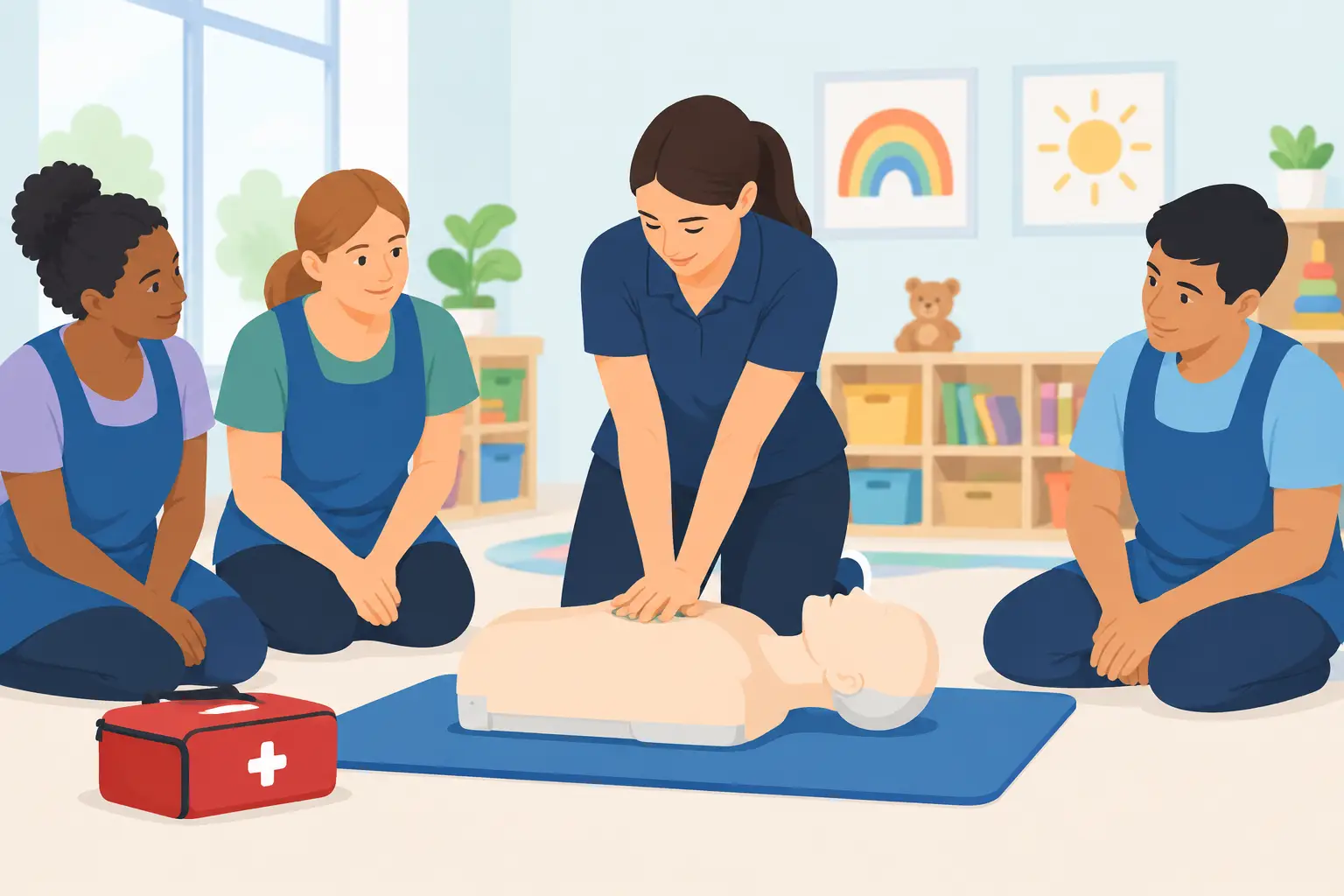
CPR Training for Daycare Staff That Builds Readiness
A child who is unresponsive, choking, or struggling to breathe does not give a daycare team time to search for instructions. The first moments belong to the adults in the room. CPR training for daycare staff prepares caregivers to recognize a life-threatening emergency, call for help, begin effective care, and work together until EMS arrives.
Preparedness is a responsibility, not just a card. For daycare directors, the goal is not simply meeting a licensing requirement. It is building a team that can act with calm, competent purpose when a child depends on them.
Why CPR Training for Daycare Staff Requires a Pediatric Focus
Daycare environments are not miniature versions of adult workplaces. Infants and children have different anatomy, common emergency risks, and emotional needs during a crisis. A caregiver must know how to respond at the right level of force, with the right technique, while keeping the rest of the classroom safe and supervised.
Pediatric-focused instruction teaches the distinctions that matter. Infant CPR requires different hand placement and compression technique than child CPR. Airway obstruction response differs by age and size. Participants need hands-on practice, not a quick review, because the correct movements must be available under pressure.
A strong course should also address the full range of people present in a daycare setting. A staff member may collapse in a hallway, a parent may experience a cardiac emergency during pickup, or a visitor may need help. Training that includes adult, child, and infant CPR gives the team practical coverage for the people who enter the facility every day.
Certification Matters, but Skills Matter More
Many states, counties, and childcare licensing authorities require specific CPR and first aid credentials for daycare personnel. Directors should confirm the requirements that apply to their license, including whether the credential must include infant and child CPR, hands-on skills assessment, or a particular issuing organization.
That compliance work is necessary. It is not the finish line.
A certificate confirms that an employee completed a course. It does not automatically mean that person can recognize agonal breathing, position an infant correctly, operate an AED, or take command when several children are crying and one needs immediate care. Training should create muscle memory and decision-making confidence through guided practice.
This is especially relevant for staff members who are new to childcare, have not used CPR since a previous certification, or feel uneasy around medical emergencies. A professional instructor can correct technique in real time, answer questions clearly, and turn uncertainty into a repeatable response process.
The Skills Every Daycare Team Should Practice
An effective daycare CPR course should center on the actions staff may need before emergency responders arrive. Participants should practice assessing responsiveness and breathing, activating 911, providing high-quality CPR, and using an automated external defibrillator, or AED, when one is available.
Choking response deserves particular attention. Small children explore with their mouths, and meals, snacks, toys, and classroom materials can create airway hazards. Staff need to recognize the difference between a child who is coughing effectively and a child with a severe airway blockage who cannot breathe, speak, or cry. They should practice age-appropriate choking relief for both infants and children, then know when to transition to CPR if the person becomes unresponsive.
Training should also reinforce team communication. In a real event, one caregiver begins care, another calls 911, another retrieves the AED and emergency records, and another moves or supervises the remaining children. Those roles will vary by staffing level and classroom layout, but the need for coordination does not.
Consider practicing these scenarios during training:
An infant becomes unresponsive during nap time.
A toddler chokes during a snack or meal.
A preschooler is found face down near a water-play area.
An adult staff member collapses while children are present.
Scenario practice reveals operational gaps that a written emergency plan can hide. Is the AED accessible? Does everyone know who calls 911? Can staff locate emergency contacts without leaving the child alone? Is there a clear plan for keeping other children calm and accounted for? These questions deserve answers before an emergency occurs.
Hands-On Practice Is Not Optional
Video-based instruction can be useful for knowledge review, but daycare staff need more than information. They need to feel the correct compression depth and rate, practice ventilations when their course includes them, and receive instructor feedback on their technique.
CPR is physical. A caregiver may understand the steps perfectly and still hesitate when placing hands on an infant manikin for the first time. Practice reduces that hesitation. Repetition helps staff deliver compressions correctly, use an AED with less delay, and work through the sequence of care without losing focus.
For directors, this is a meaningful trade-off to consider when evaluating course options. The quickest training format may reduce time away from the classroom, but it may not give employees enough skills practice to respond confidently. A well-organized on-site group course can limit disruption while still allowing every participant to demonstrate the critical skills.
Build Training Around the Daycare’s Emergency Plan
CPR training is strongest when it supports the procedures already in place at the center. Before a class, leadership should review the emergency action plan and make sure it reflects the facility’s current staffing, room assignments, access points, and communication procedures.
Staff should know where emergency supplies are kept, how to access the AED, who meets EMS at the entrance, and how families will be notified after an incident. They should also understand documentation expectations and the importance of reporting the event according to organizational and licensing procedures.
Do not assume every employee knows the plan because it was covered during orientation. New hires, float staff, substitutes, kitchen personnel, and administrative employees may all be present when an emergency begins. Their responsibilities may be different, but they need to know how to activate help and support the response.
A useful approach is to discuss the plan immediately after the hands-on session. While the techniques are fresh, walk through how they apply to actual classrooms, playgrounds, entrances, and nap areas. This turns general CPR knowledge into site-specific readiness.
Choosing a Course Provider for Your Team
Daycare leaders should look for instruction that is legitimate, current, and built around real skills rather than compliance alone. Ask whether the course includes adult, child, and infant CPR; choking response; AED practice; and instructor-led skills evaluation. Confirm that the certification meets the requirements of your licensing authority before scheduling.
The instructor’s background also matters. EMS-informed teaching brings valuable perspective to scenario training because it connects classroom skills to what happens before first responders arrive. Staff benefit from direct, practical coaching that explains not only what to do, but why each action affects the outcome.
For organizations with 10 or more employees, on-site group training can be the practical choice. It allows staff to train together in a familiar setting, supports consistent emergency procedures, and reduces the scheduling burden of sending employees to separate classes. BLS Updates provides hands-on group training designed to help organizations build that kind of operational readiness.
Keep Readiness Active Between Certifications
Certification periods can create a false sense that training is complete for years at a time. Skills fade when they are not revisited. Short, scheduled drills can keep the response plan active without turning every staff meeting into a full training session.
Review the location of the AED and first aid supplies. Assign and rotate emergency roles. Practice making a concise 911 call with the facility address, entrance instructions, and the child’s condition. Revisit how one staff member maintains care while another supervises the class.
Equipment readiness deserves the same discipline. Check AED status indicators according to the manufacturer’s instructions, verify that supplies are accessible, and replace expired items promptly. A locked cabinet, missing key, dead AED battery, or outdated emergency contact sheet can cost precious time.
A Standard Families Can Feel
Parents trust daycare professionals with the people they value most. They may never see a caregiver practice CPR, inspect an AED, or rehearse an emergency handoff. But they will feel the difference in a center where safety is organized, visible, and taken seriously.
The right CPR training gives daycare staff more than a completed requirement. It gives them the ability to recognize the moment, take control of the response, and provide meaningful care until help arrives. When the emergency is real, that preparation can become the reason a child gets another chance.
Comments